The Best Treadmill and Rower Workouts for HYROX Training
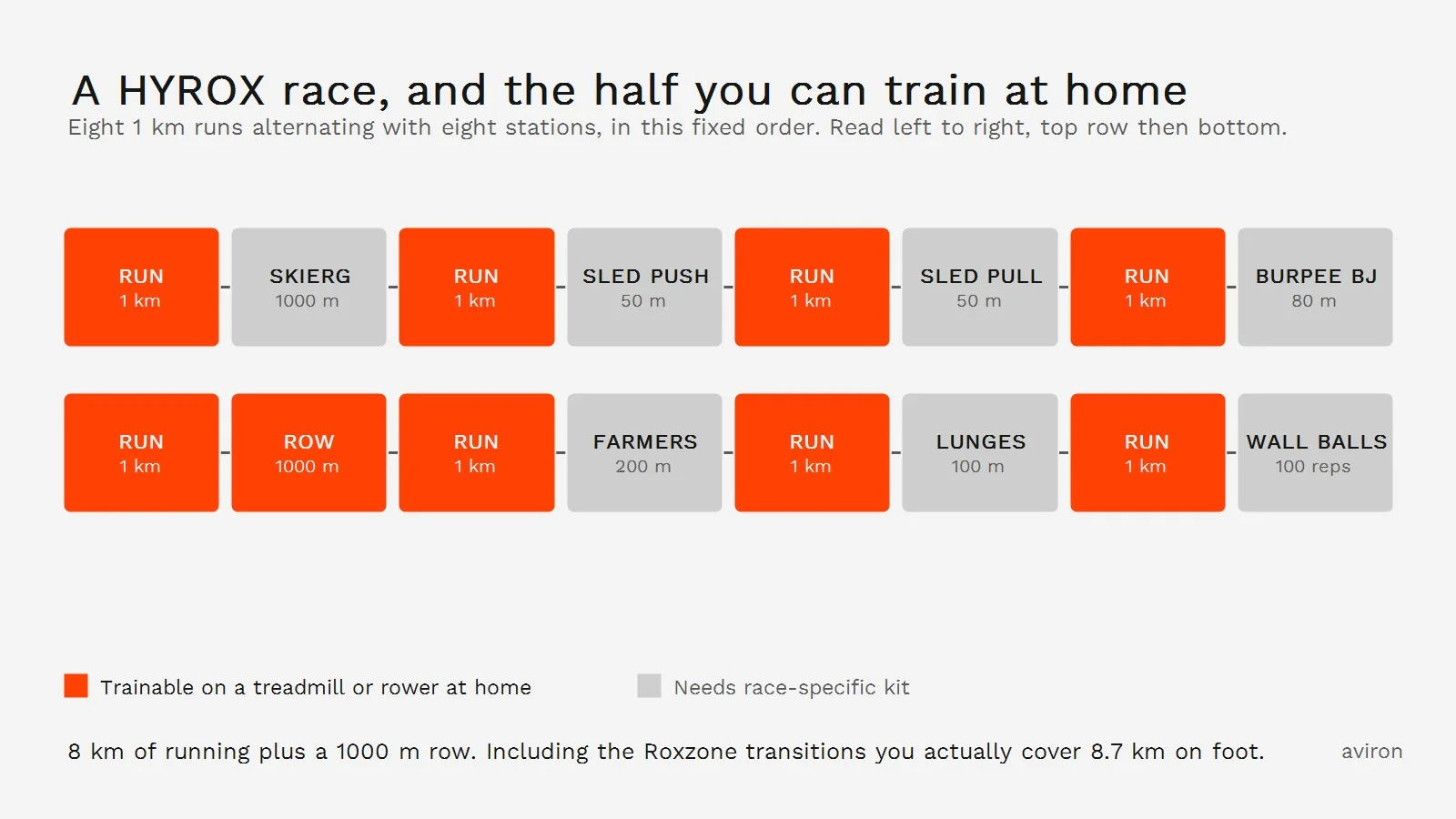
Running is roughly half of a HYROX race, and the 1000m row is the fifth station, so a treadmill and a rower cover nine of the sixteen segments you will face. The workouts that matter most are the ones that rehearse running on tired legs and holding an exact split when your heart rate is already high. Here are eight of them, four per machine.
HYROX is 8 x 1km runs alternating with 8 stations, always in the same order, which makes it unusually trainable. You know the distances in advance. You know what comes next. What you cannot fake is arriving at run five with legs that already did burpee broad jumps.
In this article
- What the race actually demands
- Your pace and split targets
- 4 treadmill workouts
- 4 rower workouts
- Fitting it into a week
- Common mistakes
- FAQ
What the Race Actually Demands
The station order never changes: SkiErg, sled push, sled pull, burpee broad jumps, row, farmers carry, sandbag lunges, wall balls. A 1km run comes before each one, and one more after the last.
Two numbers reframe how you should train. First, the running is not 8km, it is about 8.7km once you count the Roxzone transitions between stations. Second, for most athletes those runs take roughly 35 to 50 minutes combined. Against an average men's Pro finish of about 1 hour 22 minutes, running is the single biggest block of your race.
Which leads to the thing every first timer learns the hard way. Your standalone 5km pace is almost irrelevant. What decides your finish is compromised running: how little you slow down on runs five through eight, when your grip is gone and your legs are full of lactate. That is a trainable skill, and a treadmill is the best tool for it because the belt will not let you quietly drift.
Your Pace and Split Targets
Set your numbers before you start, then train against them. Find your goal 1km run pace and the matching belt speed, then the 1000m row target and its 500m split.
| Level | 1 km run | Belt speed | 8 runs total | 1000 m row | 500 m split |
|---|---|---|---|---|---|
| Competitive | 4:30 | 8.3 mph | 36:00 | 3:30 | 1:45 |
| Strong | 5:00 | 7.5 mph | 40:00 | 4:00 | 2:00 |
| Mid-pack | 5:30 | 6.8 mph | 44:00 | 4:30 | 2:15 |
| First timer | 6:15 | 6.0 mph | 50:00 | 5:30 | 2:45 |
One honest caveat. HYROX races on Concept2 ergs, and split numbers do not always transfer exactly between machines. Train the engine, the stroke and the pacing discipline at home, then calibrate on race equipment when you get the chance. We covered the differences in Concept2 vs Aviron.
4 Treadmill Workouts for HYROX
1. The 8 x 1km race simulation
The cornerstone session. Run 1km at goal race pace, step off, do 60 to 90 seconds of any hard bodyweight work (burpees, lunges, wall balls if you have a ball), then straight back on for the next kilometre. Repeat eight times.
The point is not the running. It is teaching your body to restart at pace with no easing-in period, which is exactly what the Roxzone does to you eight times on race day. Do this once every two weeks, no more.
2. Compromised running intervals
The shorter, more frequent version. 6 x 800m at slightly faster than goal pace, with 40 wall balls or 30 burpees between each. Keep total time under 40 minutes.
Watch the belt speed rather than how you feel. The whole skill is noticing that you want to slow down and choosing not to, and a treadmill makes that decision explicit in a way road running never does.
3. The negative split long run
Elite HYROX athletes hold their pace across runs one to four and manage a small drop across five to eight. Rehearse the opposite in training so race day feels easy by comparison: run 8km continuously, starting 30 seconds per km slower than goal pace and finishing 15 seconds per km faster.
This builds the aerobic base that makes everything else survivable. If you are new to running volume, our indoor half marathon plan is a good base-building framework to borrow from.
4. Incline strength repeats
Sled push and sled pull are the two stations that wreck legs before the back half of the race. You cannot replicate a sled on a treadmill, but you can build the same forward-lean drive: 8 x 90 seconds at 8% to 12% incline, walking or jogging hard, with 90 seconds easy between.
Aviron's Summit reaches 42% if you want to push this further, but honestly 12% is plenty for HYROX specificity.

14 MPH and an 18% incline on a 22 inch by 60 inch deck, so race-pace repeats and sled-sim hill work both fit on one machine.
4 Rower Workouts for HYROX
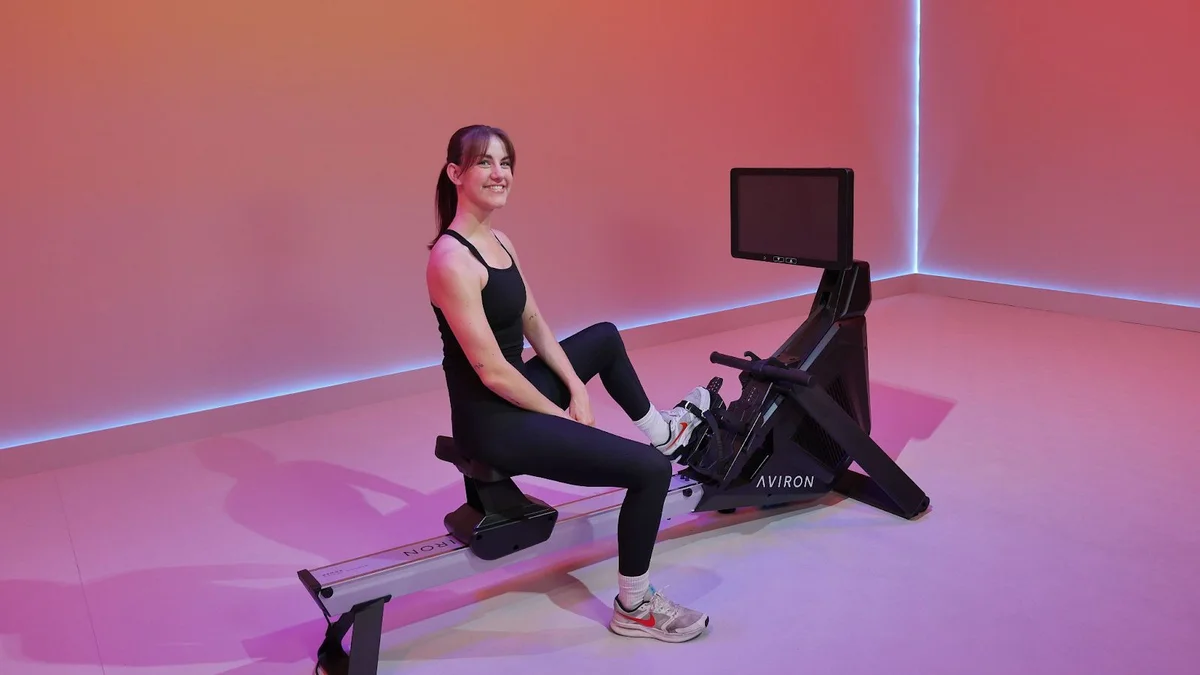
The row lands at station five, right in the middle, and a 1000m row typically takes 3:30 to 6:30 depending on fitness. It is also the one station where good technique buys you free time, because most people row it badly.
5. The 1000m time trial
Once a month, fresh, all out. This sets the target split for everything else and tells you honestly whether you are improving.
Pace it evenly or slightly negative, meaning the second 500m is the same or faster than the first. The opening 250m always feels easy. Hold your target anyway, because going out ten seconds hot costs you far more than it gains.
6. 4 x 1000m at race split
Four rounds at your target 1000m pace with three minutes easy between. The aim is four near-identical splits, not a fast first one.
This is the session that turns your time trial number into something you can actually produce mid-race. Stroke rate should sit in the mid-20s to low-30s. Higher than that on a 1000m usually means you are pulling with your arms and burning the grip you need for farmers carry.
7. The run-row-run brick
The most race-specific thing you can do at home with two machines. 1km run at goal pace, straight into a 1000m row at goal split, straight back into a 1km run. Rest five minutes. Repeat two or three times.
Nothing else teaches you what your legs feel like when you stand up off the rower and have to run immediately. Expect the second run to be ugly the first few times you try it.
8. Stroke rate ladder
5 x 500m, holding the same split at 22, 24, 26, 28 and 30 strokes per minute. Two minutes easy between.
Holding one split across five rates forces you to generate power with your legs rather than by flailing faster. It is the single best technical drill for the HYROX row, and it transfers straight into a more efficient stroke on race day. If you want more on this, see how to row a faster split.

Dual air and magnetic resistance with 160 levels, adjustable mid-workout, plus live races when a solo interval session needs an opponent.
Fitting It Into a Week
Three machine sessions a week alongside your strength work is plenty. A workable rotation:
- Monday: compromised running intervals (workout 2)
- Wednesday: rower session, alternating workouts 6 and 8 week to week
- Saturday: negative split long run (workout 3), or the run-row-run brick (workout 7) every third week
- Every second week: swap one session for the full 8 x 1km simulation (workout 1)
Run the 1000m time trial (workout 5) once a month to check progress, and taper hard in the last ten days before a race.
Common Mistakes
- Training runs fresh. Your 5km time is not the test. Running well tired is. If every run starts rested, race day will surprise you at station five.
- Sprinting the first 250m of the row. It feels free. It is not. Hold the target split from the first stroke.
- Pulling with the arms first. Legs, then body, then arms. Opening the back early costs power and burns the grip you still need for farmers carry.
- Rushing the recovery. Slamming into the catch is inefficient and hard on your back. Let the slide come back under control.
- Ignoring the Roxzone. Those transitions add around 700m of running. practice starting at pace instead of jogging the first 100m of every interval.
Frequently Asked Questions
Can you train for HYROX with just a treadmill and a rower?
You can cover the running and the row, which is nine of the sixteen race segments and the largest single block of your finish time. You will still need to train sled work, burpee broad jumps, farmers carry, lunges and wall balls separately, along with the SkiErg. Treat the two machines as the aerobic engine and train the stations alongside them.
How far do you actually run in a HYROX race?
Eight kilometres of official running, in 1km segments. Counting the Roxzone transitions between stations, most athletes cover about 8.7km on foot. Plan your pacing around the larger number.
What is a good 1000m row time for HYROX?
Most athletes finish the row between 3:30 and 6:30. Around 4:00, a 2:00 per 500m split, is a solid competitive target for men, with 4:30 a strong benchmark for a mid-pack finisher. Consistency across the whole 1000m matters more than the number itself.
What is compromised running?
Running immediately after a hard station, with fatigued legs and an elevated heart rate. It is the defining skill of HYROX, because everyone slows down across runs five to eight and the winner is whoever slows down least. You train it by always putting hard work directly before your running intervals.
How many days a week should I train for HYROX?
Four to five, typically three machine-based conditioning sessions plus two strength sessions. More than that and recovery becomes the limiter, particularly in the last six weeks before a race when session quality matters more than volume.
Does rowing help your HYROX run?
Yes, in two ways. It builds aerobic capacity without the impact cost of more running mileage, which matters when you are already running several times a week. It also strengthens the posterior chain that sled work and lunges demand. See rowing vs running for full-body conditioning for the detail.
Train the half of HYROX you control
A rower and a treadmill cover the runs and station five. Both run the same library of races, intervals and games, so the boring sessions stop being boring.
Shop Aviron →30-day risk-free home trial · Free shipping · 0% APR financing via Affirm · HSA/FSA eligible


