How to Train for a Half Marathon Indoors
You can train for a half marathon entirely on a treadmill in 12 weeks. Run four times a week, set the belt to a 1% incline to match the effort of running outside, and build your long run from 4 miles to 11 miles with a cutback week every third or fourth week. You do not need to run the full 13.1 in training. Race day covers the gap.
Indoor training gets treated as the backup plan, the thing you settle for when it is dark or icy. It is not. The belt holds an exact pace, the surface never changes, and nothing gets cancelled. The one real problem is boredom, and that is a solvable problem. Here is the whole plan.
In this article
- What you need before you start
- Step 1: Work out your goal pace
- Step 2: Set the incline to 1%
- Step 3: Build your week around four runs
- Step 4: Grow the long run over 12 weeks
- Step 5: Taper for the last 10 days
- How do you survive two hours on a treadmill?
- Common mistakes
- FAQ
What You Need Before You Start
- A treadmill with a deck you can run on. Look for a running surface of at least 20 inches by 55 inches and a motor of 3.0 CHP or more. Anything smaller works for walking, not for a 90 minute long run.
- 12 weeks. You can compress it to 10 if you already run comfortably for 45 minutes. Do not compress it to 6.
- A base of about 10 miles a week. If you are starting from zero, spend a month building to that first.
- A fan and a water bottle. There is no headwind indoors, so you will run hotter than you expect and sweat more.
- Something to occupy your head. The single biggest reason indoor plans fail. More on that below.
Step 1: Work Out Your Goal Pace
A treadmill gives you something the road cannot: an exact, unarguable pace. Use it. Start by turning your goal finish time into a belt speed.
| Goal finish | Pace per mile | Belt speed | Easy run speed |
|---|---|---|---|
| 1:45 | 8:01 | 7.5 mph | 6.0 to 6.5 mph |
| 2:00 | 9:09 | 6.6 mph | 5.3 to 5.7 mph |
| 2:15 | 10:18 | 5.8 mph | 4.7 to 5.0 mph |
| 2:30 | 11:27 | 5.2 mph | 4.2 to 4.5 mph |
The last column matters more than the third. Most of your running should be genuinely easy, slow enough to hold a conversation. If every run is at goal pace, you are training your body to be tired, not fast.
Step 2: Set the Incline to 1%
Running indoors is slightly easier than running outdoors at the same speed, because there is no air to push through. The fix is a small incline, and the number comes from an actual study rather than gym folklore.
In 1996, Jones and Doust tested trained runners on a treadmill at a range of grades against running outdoors, and found that a 1% grade most accurately reflects the energetic cost of outdoor running (Journal of Sports Sciences, 14:4, 321 to 327). That is where the rule comes from.
Here is the part almost everyone leaves out: they tested speeds from 2.92 to 5.0 metres per second, which is roughly 6.5 mph to 11.2 mph, or 9:11 down to 5:22 per mile. If you are targeting a 2:15 or 2:30 half, your training pace sits below that range, and air resistance is a smaller factor at slower speeds. Run at 0% to 1% and do not agonise over it. The 1% rule is a useful correction for faster runners, not a law of physics for everyone.
Step 3: Build Your Week Around Four Runs
Four runs a week is the sweet spot for a half. Enough volume to build real endurance, few enough sessions to recover between them.
- Easy run (30 to 40 minutes). Conversational. This is the one people run too fast.
- Intervals (35 minutes). Warm up 10 minutes, then 6 x 3 minutes at about 30 seconds per mile faster than goal pace, with 90 seconds easy between. Cool down. The treadmill is genuinely better than the road here, because it holds the pace for you.
- Tempo run (35 to 45 minutes). Warm up, then 20 to 30 minutes at goal pace, then cool down. This is your dress rehearsal.
- Long run (see the chart below). Slow. About 60 to 90 seconds per mile slower than goal pace.
Add one or two cross-training days if you want more aerobic work without more pounding. Indoor cycling and rowing both build the engine while giving your legs a break from impact.
Step 4: Grow the Long Run Over 12 Weeks
The long run is the session that makes or breaks a half marathon. Build it steadily, and pull it back every third or fourth week so your body can absorb the work.
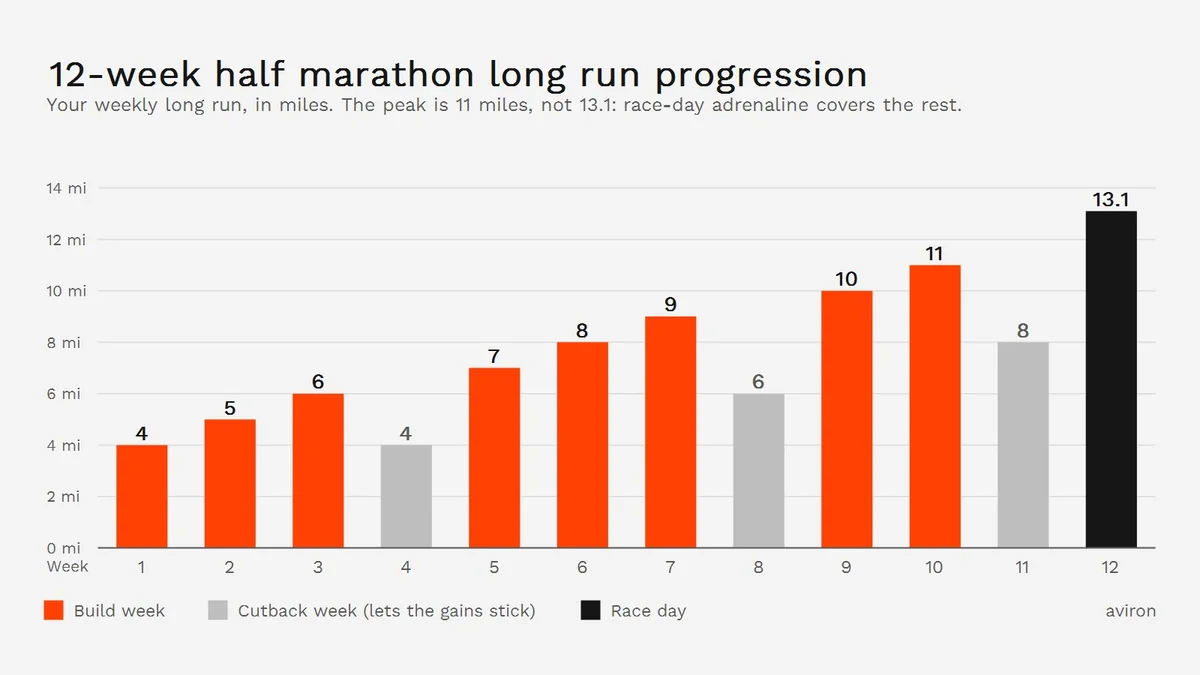
Notice the peak: 11 miles, not 13.1. Running the full race distance in training adds fatigue without adding much fitness, and it eats into the taper. On race day, the crowd, the adrenaline and two weeks of fresh legs cover the last two miles comfortably.
If your race has hills, spend some of the long run on a grade instead of adding distance. Ten minutes at 4% to 6% teaches your legs far more about climbing than another flat mile does. Just be honest about what your machine can do, since most treadmills stop at 15%.

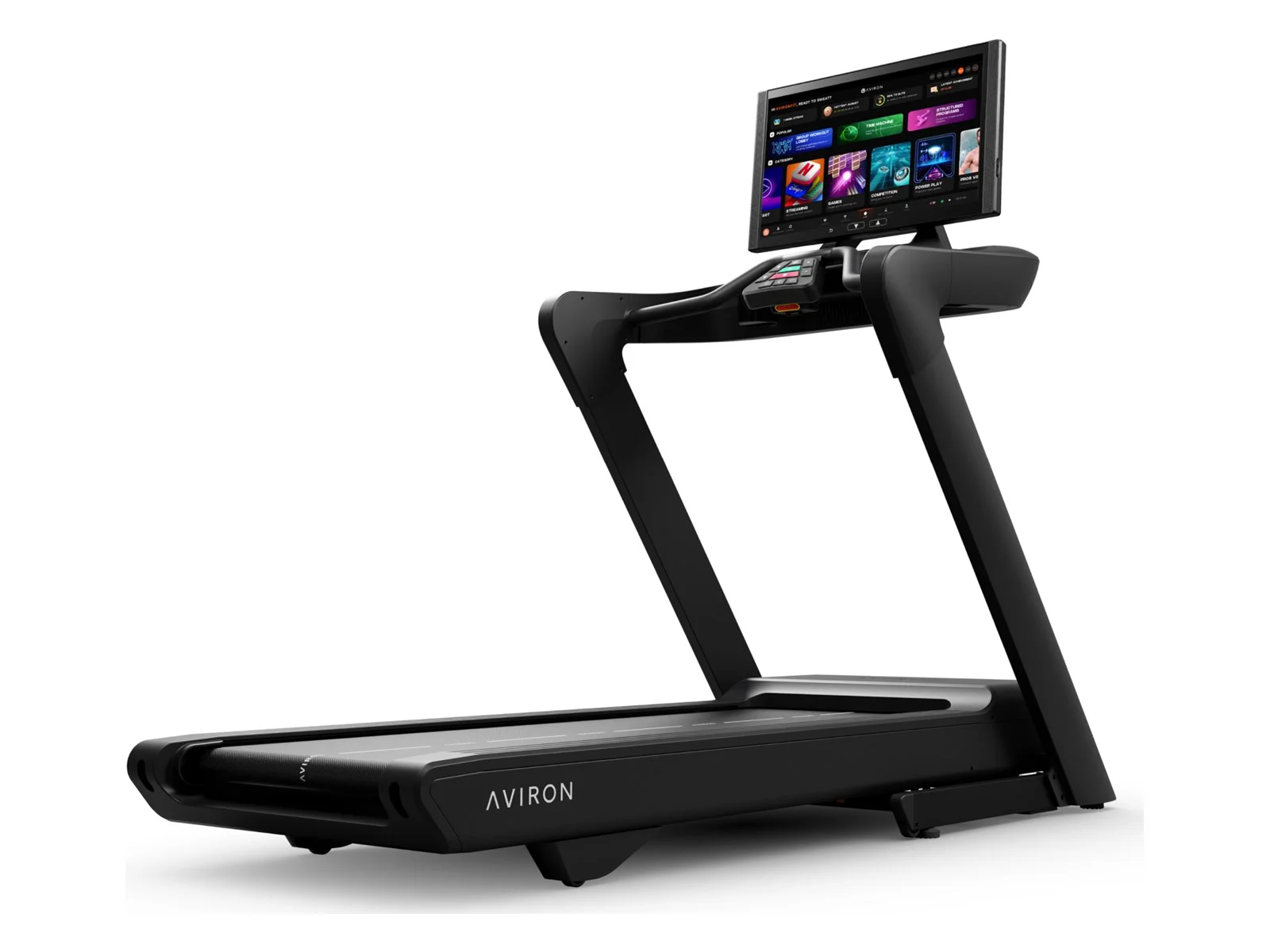
A 4.5 CHP motor, 14 MPH top speed and a 22 inch by 60 inch deck, so your stride still has room at mile 10. Folds away between sessions.

Climbs to 42% and drops to a 6% decline, so you can train the descents too. Downhill running is what wrecks quads on a rolling course.
Step 5: Taper for the Last 10 Days
Cut your weekly volume by roughly 40% in the final 10 days, but keep the intensity. Short, sharp sessions at goal pace keep your legs sharp while the fatigue drains away.
Two days before the race, run 20 easy minutes with four 30 second pickups at goal pace. The day before, rest or walk. Tapering feels wrong, like you are losing fitness. You are not. The work is already banked.
How Do You Survive Two Hours on a Treadmill?
This is the actual obstacle. Nobody quits an indoor half marathon plan because their quads gave out in week seven. They quit because week seven's 9 miler felt like staring at a wall for 90 minutes.
A few things that work. Break the run into blocks so you are counting to six rather than to nine: change something every mile, whether that is a slight incline bump, a route, or a track. Cover the display on easy runs, because watching the distance tick over makes it crawl. And give your attention somewhere to go, which is the whole reason Aviron builds the workout around games, scenic routes, coached classes and head-to-head races rather than a number counting up.
It is the same behavioural science that makes your phone hard to put down, pointed at something useful. It is also why 92% of Aviron members are still working out a year later.
Common Mistakes
- Running every session at goal pace. The most common error by a distance. Easy days must be easy.
- Jumping the long run too fast. Add no more than a mile a week, and take the cutback weeks seriously.
- Holding the handrails. It changes your gait and quietly reduces the effort. If you need them, slow the belt down.
- Forgetting to drink. No wind means more sweat. Practise drinking on the move during long runs, exactly as you would in the race.
- Never training on a hill. If your race climbs and every one of your runs was flat, the first incline will be a shock.
Frequently Asked Questions
Can you really train for a half marathon only on a treadmill?
Yes. Every element of half marathon training, including easy miles, intervals, tempo runs and long runs, works indoors. The one thing a belt cannot teach is uneven ground and cambered roads, so if your race is on trails, get at least a couple of outdoor runs in beforehand.
How long does it take to train for a half marathon?
Twelve weeks if you can already run about 10 miles a week. Sixteen weeks if you are starting closer to zero. Ten weeks is workable if you run regularly and are not chasing a time.
Should I run 13.1 miles before race day?
No. Peak at 10 to 11 miles. The extra distance adds fatigue and injury risk without meaningful fitness gains, and race day conditions carry you through the final stretch.
Is treadmill running easier than running outside?
Slightly, at the same speed, because there is no air resistance to overcome. A 1% incline closes the gap for runners moving faster than about 6.5 mph. At slower paces the difference is small enough to ignore.
What speed should I set for a half marathon pace run?
For a 2:00 finish, 6.6 mph. For 2:15, 5.8 mph. For 2:30, 5.2 mph. For 1:45, 7.5 mph. Set easy runs about 1 mph slower than the figure for your goal.
How do I stop getting bored on long treadmill runs?
Split the run into segments with a small change at each one, avoid watching the distance counter on easy days, and pick a machine whose screen gives you something to do. Games, scenic routes, classes and live races all work far better than a stopwatch.
13.1 miles starts with one indoor run
The Podium holds your pace exactly, and Aviron World makes sure week seven does not feel like a wall.
Shop the Podium →30-day risk-free home trial · Free shipping · 0% APR financing via Affirm


