Why Exercise Feels Easier When It Is Actually Enjoyable
Because effort is a perception, not a measurement. Your heart rate, your power output and your oxygen use are physical facts. How hard it feels is something your brain assembles, and it uses your attention as an ingredient. Give your attention somewhere better to be and the same workload registers as easier, by roughly 10% at low to moderate intensity.
That is not a motivational slogan. It is a measured effect with a name, and it comes with an important limit that most articles on this subject skip. Here is how it actually works.
In this article
- Effort is a perception
- The 10% discount, and its ceiling
- Why "during" matters more than "after"
- What this means the fitness industry gets wrong
- How to use it
- FAQ
Effort Is a Perception
Exercise scientists separate two things that most of us treat as one. There is the physiological load, which is what your body is actually doing. And there is perceived exertion, which is your subjective read on how hard that feels.
They are correlated, but they are not the same, and the gap between them is where all the interesting stuff lives. Two people on identical machines at identical speeds can report very different levels of effort. So can the same person on two different days, on the same machine, at the same speed.
Part of what fills that gap is attention. When you focus inward on your breathing, your burning legs and the number counting up, you are attending to fatigue signals. When your attention is somewhere else, those signals get less of your processing. The workload has not changed. The reading you take of it has.
The 10% Discount, and Its Ceiling
The technical term for directing attention away from fatigue is dissociation, and its effect has been measured repeatedly, most thoroughly in the research on music.
In their review of the field, Karageorghis and Priest found that "during exercise of a low-to-moderate intensity, music is associated with a ~10% reduction in RPE", where RPE is the standard rating of perceived exertion. Ten percent, for free, from something that changes nothing about the physical work.
Now the limit, which matters just as much. That discount stops applying as intensity rises. Past the anaerobic threshold, the same authors write, "the internal feedback associated with exertion during high-intensity exercise dominates the perceptual field." Your body's alarm signals get loud enough that nothing else gets a look in. No playlist, no game and no television show will make an all-out effort feel moderate.
But they offer a distinction worth keeping. Even when it cannot change what you feel, engagement can still change how you feel it. The effort stays hard. Whether the experience is miserable is a separate question.
| Intensity | Can you talk? | Does distraction lower perceived effort? |
|---|---|---|
| Low to moderate | Full sentences | Yes, around 10% |
| Hard | Short phrases | Diminishing |
| Above threshold | A word at a time | No, but it can still improve mood |
This is the honest version, and it has a practical consequence. The sessions where enjoyment does the most work are your easy and moderate ones, which is most of them for most people.
Why "During" Matters More Than "After"
Here is the finding that should change how you choose workouts.
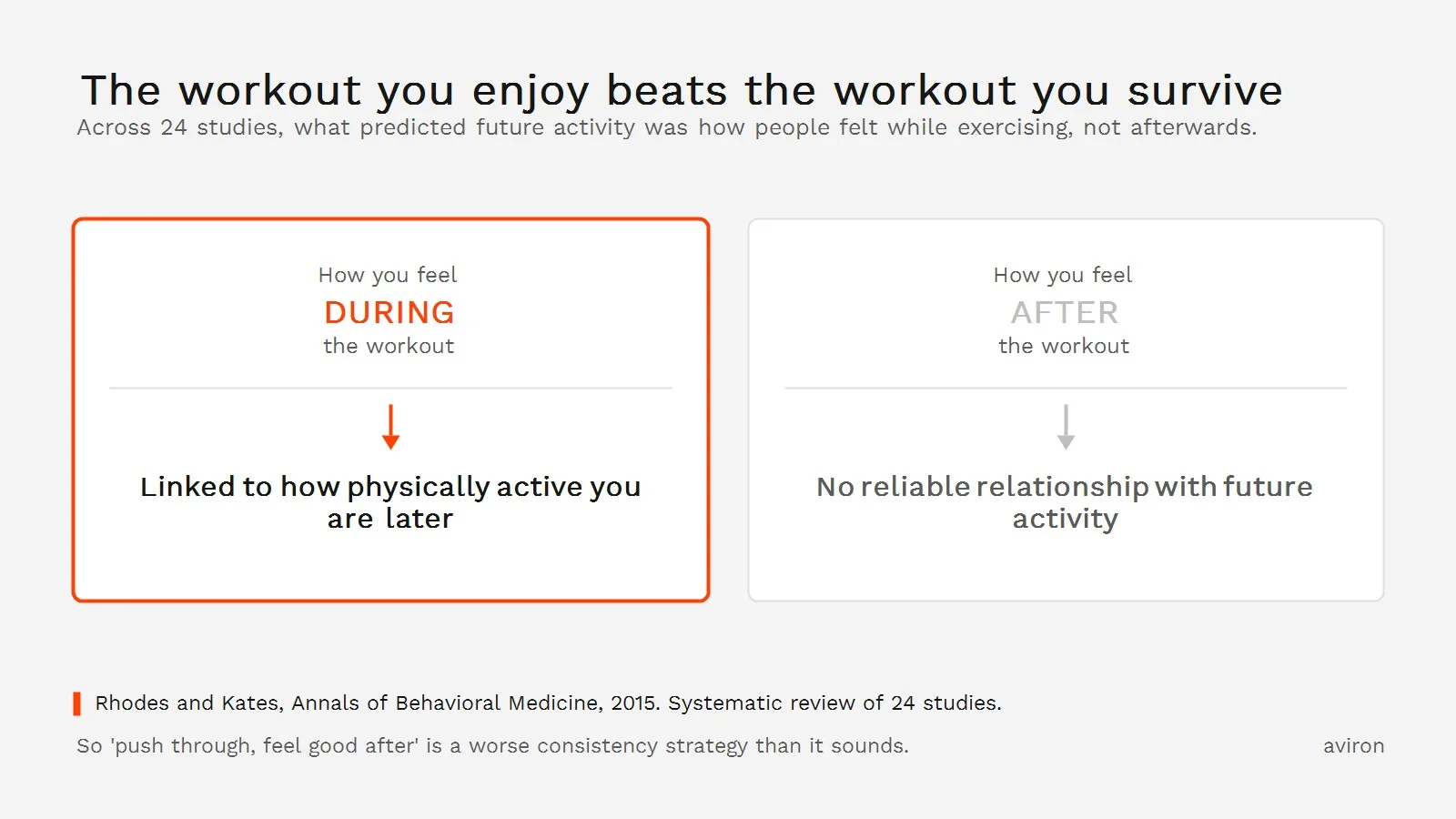
Rhodes and Kates reviewed 24 studies on whether the way people feel about exercise predicts whether they keep doing it. Their conclusion was that a positive affective response during moderate-intensity exercise was linked to future physical activity, while post-exercise affect had a null relationship.
Read that again, because it is the opposite of the advice everybody gives. The glow afterwards, the thing we are told to focus on, the "you never regret a workout" line: as a predictor of whether you will still be doing this in six months, it did not hold up. What held up was whether the workout itself felt good while it was happening.
Individual studies point the same way. Williams and colleagues followed sedentary adults after a single moderate-intensity session and found their affective response during it predicted how physically active they were 6 and 12 months later. That was a small study, 37 people, so treat it as illustrative rather than conclusive. The review across 24 studies is the sturdier evidence.
What This Means the Fitness Industry Gets Wrong
Almost all fitness marketing is built on endurance of discomfort. No pain, no gain. Earn your rest. The suffering is the product.
If the goal is a single hard session, that framing works fine. If the goal is still training in a year, it is pointed at the wrong variable. It optimizes for the after, which does not predict much, while treating the during as something to grit your way through, when the during is the part that carries the signal.
It also explains something that otherwise looks like a personal failing. People who abandon equipment in month two are usually not lazy and usually not short of willpower. They have simply been running an experiment in which every session is unpleasant, and the accumulated evidence says do not repeat this. That is not weakness. That is learning working correctly.
This is the entire premise Aviron is built on. If enjoyment during the workout is what predicts whether you return, then the software is not decoration around the machine. It is the mechanism. Games you play by rowing, races against other members, scenic routes and streaming are all ways of putting your attention somewhere other than the fatigue. It is also why 92% of Aviron members are still working out a year later.
How to Use It
- Give your attention a destination before you start. Not something you will reach for at minute eight when it already hurts. Decide the show, the game or the playlist first.
- Put the engagement on your easy days especially. That is where the effect is strongest and where most of your volume should sit anyway.
- Stop watching the numbers on steady sessions. A metrics display is an invitation to focus inward, which is the opposite of what you want. Cover it.
- Judge a workout by how it felt at minute fifteen, not by how virtuous you feel at the end. That reading is the one that predicts next month.
- If you dread it, change it rather than pushing harder. Dread is data. It is telling you this particular format will not survive the winter.
None of this argues against hard training. Intervals build things easy work cannot, and above threshold you will simply have to be uncomfortable. The argument is narrower: for the large majority of your sessions, which are the easy and moderate ones, enjoyment is not a luxury bolted onto the training. It is part of what makes the training keep happening.
If you want the practical version of this, we wrote about why variety keeps you consistent and how games change a workout.

Games you control by rowing, live races and streaming apps on a 22 inch screen, so the fatigue is not the most interesting thing in the room.
Frequently Asked Questions
Does distraction actually make exercise easier?
It makes it feel easier, which is a real effect rather than a trick. Research on music in exercise finds roughly a 10% reduction in rating of perceived exertion at low to moderate intensity. The physical work is unchanged, but your perception of the effort drops, and perception is what determines whether you want to do it again.
Why does music make workouts feel easier?
Through dissociation, meaning your attention moves away from internal fatigue signals like breathing and burning muscles. Those signals still exist, but they get less of your attention, so the effort registers as lower. The effect is reliable at easy and moderate intensities and fades as intensity climbs.
Does it still work during hard intervals?
Much less. Beyond the anaerobic threshold, physiological feedback dominates your attention and distraction cannot override it. It can still improve your mood during the session even when it does not lower perceived effort, but do not expect a game to make a hard interval feel easy.
Does enjoying exercise make you more likely to stick with it?
The evidence points that way, with a specific twist. A systematic review of 24 studies found that positive feeling during moderate exercise was linked to future physical activity, while how people felt afterwards showed no reliable relationship. Enjoying the session itself appears to matter more than the sense of accomplishment at the end.
Is it bad to distract yourself from a workout?
Not for general fitness. Focusing internally on form and breathing has its place, particularly when learning a movement or racing, but for everyday aerobic work the evidence favors letting your attention go elsewhere. The best workout is the one you repeat.
What is rating of perceived exertion?
A standard scale used in exercise science for how hard an effort feels to the person doing it, rather than what the machine or the heart rate monitor says. It is subjective by design, and the fact that it can be shifted by attention, music and mood is precisely what makes it useful.
Stop trying to want it more
Change what the workout feels like instead. Games, races, routes and classes on every Aviron machine, for $29 a month billed annually.
Find your machine →30-day risk-free home trial · Free shipping · 0% APR financing via Affirm · HSA/FSA eligible


