How to Maintain Your Fitness Routine Through Fall and Winter
To keep training through fall and winter, shrink the workout instead of skipping it, move it indoors so weather stops being a vote, and rotate between different types of exercise so boredom never catches up. Consistency in winter is not a willpower problem. It is a friction problem, and friction is something you can design out.
Almost nobody quits in October. They miss one session because it is dark and cold, then another, and by January the habit is gone and they are buying a resolution. Here is how to not let that happen this year.
In this article
- Why fall and winter break routines
- 1. Shrink the workout before you need to
- 2. Cut the friction between you and starting
- 3. Rotate modalities so boredom never lands
- 4. Chase the streak, not the session
- 5. Get light early, train whenever
- What if you have already stopped?
- FAQ
Why Fall and Winter Break Routines
Three things change at once, and none of them are about how much you want it.
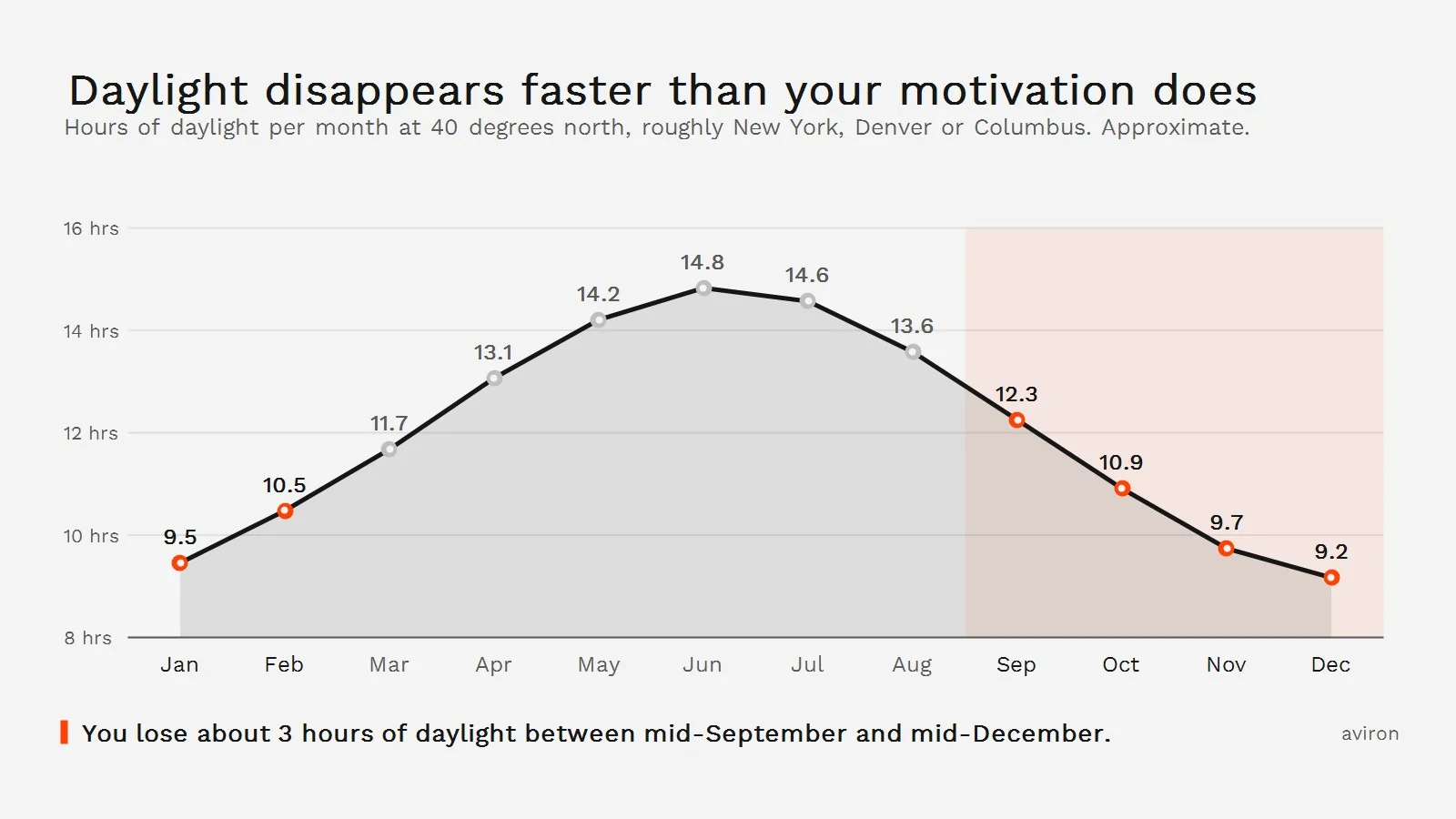
The daylight goes. At around 40 degrees north, roughly the latitude of New York, Denver or Columbus, you lose about three hours of daylight between mid-September and mid-December. Clocks go back on Sunday, November 1 this year, and the evening slot where your workout used to live simply stops existing.
Your mood follows it. In an American Psychiatric Association Healthy Minds poll of 2,211 adults, 38% of Americans said their mood declines in winter, two thirds reported behavioural changes, and a third said they sleep more. For a smaller group this is clinical: the National Institute of Mental Health describes winter-pattern seasonal affective disorder as lasting four to five months of the year. If that sounds like you, talk to a doctor rather than trying to out-train it.
Every workout gains steps. In July you put on shoes and go. In January you need layers, lights, grip, and a decision about whether the sidewalk is ice. Each step is small. Together they are the reason you are still on the sofa at 7pm.
1. Shrink the Workout Before You Need To
The instinct in autumn is to hold the line: same 60 minutes, same intensity, just indoors. It rarely survives December.
Set a deliberately small floor instead, and set it now while you still feel motivated. Ten minutes counts. A ten minute row on a Tuesday night when you feel like nothing is worth vastly more than a perfect hour you keep postponing, because the ten minutes keeps the identity intact. You are still someone who trains. That is the thing worth protecting through February.
In practice most people who sit down for ten minutes do twenty. But the deal you make with yourself has to be ten, honestly, with no guilt attached if you stop there.

Rowing hits most of your body at once, which makes it the best value per minute when minutes are short.
2. Cut the Friction Between You and Starting
Count the steps between sitting down after work and being three minutes into a workout. Every one you remove buys you a session in January.
- Keep the equipment out and visible. A machine you have to reassemble is a machine you will not use. If space is tight, a folding treadmill that stands up in seconds beats a perfect setup in a spare room you never enter.
- Leave your kit where you will trip over it. Not in a drawer. On the chair.
- Decide the workout in advance. Choosing what to do is its own barrier at 7pm in November. Pick tomorrow's session tonight.
- Stack it onto something that already happens. Straight after the school run, straight after the last meeting, before the shower you were going to take anyway.
Training at home removes the biggest step of all, which is going outside. Weather stops being a vote. So does darkness, so does ice, and so does the last minute cancellation of whatever class you had booked.
3. Rotate Modalities So Boredom Never Lands
Winter training fails from monotony more than from fatigue. The same 30 minutes on the same machine, in the same room, in the dark, four days a week, is a lot to ask of anyone in February.
Rotating between different kinds of work fixes it twice over: your head gets novelty, and your body gets a break from repeating one movement pattern. Here is a week that covers everything without ever repeating a session.
| Day | Modality | Session | Time |
|---|---|---|---|
| Mon | Rower | Full body intervals, hard but short | 20 min |
| Tue | Treadmill | Incline walk while you watch something | 30 min |
| Wed | Core | Short core session, the easiest day to keep | 10 min |
| Thu | Bike | Scenic ride or a race, low impact | 25 min |
| Fri | Rest | Actually rest | 0 min |
| Sat | Treadmill or bike | The long, easy one. Games or a class | 40 min |
| Sun | Rower | Easy steady pace, no numbers | 20 min |
Nothing there is punishing, and no two days feel the same. That is the point. We wrote more about why this works in the science of workout variety.

Belt driven and quiet enough for a flat at 6am, with scenic routes for the days you want scenery rather than a scoreboard.

Justice folds away and doubles as a walking desk, Podium is built for runners, and Summit climbs to 42% for hill work.

Turns plank work into a game using your phone's motion sensors. Small, quiet, and the easiest thing to say yes to on a bad night.
4. Chase the Streak, Not the Session
In summer, progress is its own reward. In winter, progress slows and the reward goes with it. You need something else to show up for.
Streaks work because they change what you are protecting. Miss a session and you are not just missing a workout, you are breaking a run of eleven. Points, badges and leaderboards do the same job. It sounds trivial until you notice it is the exact mechanism keeping you on your phone at midnight.
That is the whole idea behind Aviron World: games you play by rowing or running, live races against other members, scenic routes, coached classes and streaming, all built on reward loops rather than a number counting up. Pick whichever one gets you moving on a given Tuesday. It is why 92% of Aviron members are still working out a year later.
5. Get Light Early, Train Whenever
Two separate problems get muddled here. Low mood and disrupted sleep in winter are largely about light exposure. Losing your training habit is about friction. Solve them separately.
For the light, get outside within an hour of waking, even on a grey day, even for ten minutes. Overcast daylight is still far brighter than indoor lighting. Then stop worrying about when you train. Evening indoor sessions are fine, and if 9pm is the only slot that survives December, take 9pm.
What If You Have Already Stopped?
Then start smaller than feels reasonable. Not the routine you had in August. One ten minute session, this week, on whichever machine you dislike least.
The trap after a lay-off is trying to make up for it, going too hard, feeling wrecked, and confirming the story that you have lost it. You have not. Fitness comes back faster than it left. Give it three weeks of small, boring consistency before you judge anything, and if you need help getting going, we wrote a whole piece on getting your motivation back.
Frequently Asked Questions
How do I stay motivated to work out in winter?
Lower the bar and remove the steps. Set a floor of ten minutes so a bad day still counts, keep your equipment out and visible, decide the session the night before, and rotate between different types of workout so nothing gets stale. Motivation follows action far more reliably than it leads it.
Why do I feel less motivated to exercise in the winter?
Partly light and partly logistics. An American Psychiatric Association poll found 38% of Americans report their mood declining in winter and a third sleep more. At the same time, every workout gains steps: darkness, cold, layers, unsafe footing. Less drive and more friction arriving together is what breaks the habit.
How many days a week should I work out in winter?
Three to five, with at least one full rest day. Frequency matters more than duration for keeping a habit alive, so four short sessions beat two long ones. If you are struggling, drop the length before you drop a day.
Is it better to work out in the morning or evening in winter?
Whichever you will actually do. Mornings pair well with getting daylight early, which helps mood and sleep. Evenings suit most schedules better. Training indoors means darkness is not a safety issue either way, so pick the slot with the fewest obstacles.
How much fitness do you lose over winter?
Less than you fear if you keep moving at all. Even one or two short sessions a week preserves most of your aerobic base, and what you do lose returns quickly. The real cost of a winter off is not fitness, it is the habit, which is much harder to rebuild than the conditioning.
Can exercise help with seasonal low mood?
Regular activity supports mood generally, and getting daylight early helps too. But winter-pattern seasonal affective disorder is a recognised condition that the National Institute of Mental Health says can last four to five months, with light therapy as a mainstay of treatment. If your symptoms are persistent or severe, speak to a doctor rather than treating it as a motivation problem.
Make it through to spring
Rowers, bikes, treadmills and core training, all running the same library of games, races, routes and classes. Membership is $29 per month billed annually, and covers every machine.
Explore Aviron World →30-day risk-free home trial · Free shipping · 0% APR financing via Affirm · HSA/FSA eligible


