HIIT Rowing Workout: 5 Interval Sessions From 10 to 30 Minutes (Beginner to Advanced)
Last updated November 2026
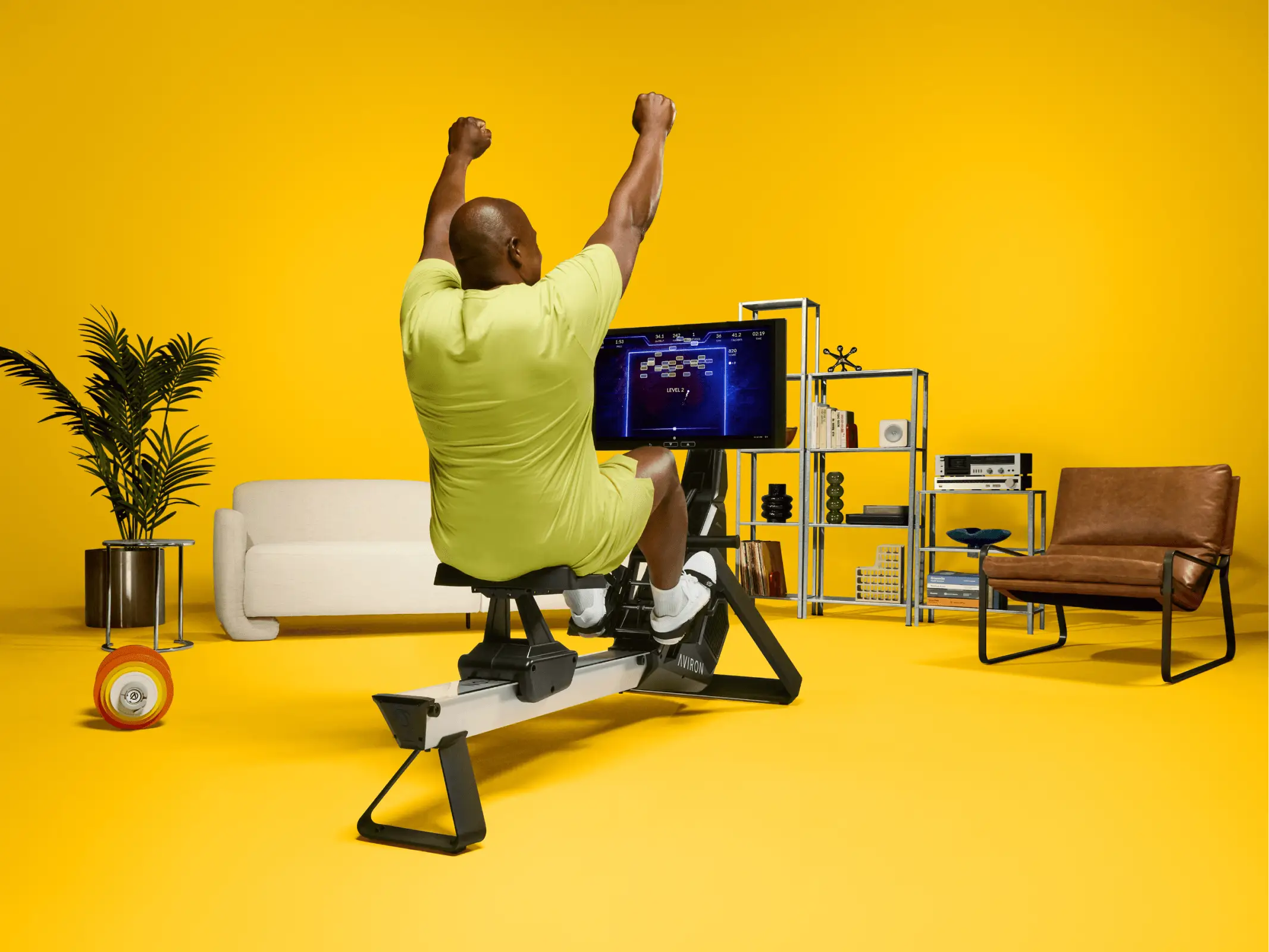
Short answer: A HIIT rowing workout alternates short, hard efforts with easy rowing to recover. Work intervals last 20 seconds to 4 minutes at about 8 or 9 out of 10 effort, and a full session takes 10 to 30 minutes, warm-up included. New to it? Start with 20 seconds hard and 40 seconds easy, six times. Two or three sessions a week is plenty. The five workouts below run from that 10-minute starter to a 30-minute 4x4.
A rower is a great machine for intervals. Every stroke works your legs, glutes, back, arms and core, nothing pounds your joints, and you can go from easy to all-out within a few strokes.
Paul Kerling's family also owns a Peloton bike and FightCamp. Here's how he sums up the rower:
"I exert more energy on this rower in the same amount of time than any other piece of fitness equipment."
You can do all five on any rowing machine. Where the Aviron Strong Series has a ready-made version, we'll point it out.
| Workout | Level | Total time | Hard / easy | Best for |
|---|---|---|---|---|
| 1. The Starter | Beginner | 10 min | 20 s / 40 s, 6 rounds | Your first HIIT session |
| 2. The Pyramid | Beginner to intermediate | 15 min | 30, 45, 60, 45, 30 s, equal easy | Learning to pace |
| 3. The 40/20 | Intermediate | 20 min | 40 s / 20 s, 10 rounds | The most work in the least time |
| 4. Double Tabata | Advanced | 20 min | 20 s / 10 s, 8 rounds, twice | All-out power |
| 5. The 4x4 | Intermediate to advanced | 30 min | 4 min / 2 min, 4 rounds | Building your aerobic engine |
In this article
- What is a HIIT rowing workout?
- How hard should HIIT rowing feel?
- 1. A 10-minute HIIT rowing workout for beginners
- 2. The 15-minute rowing pyramid
- 3. The best 20-minute HIIT rowing workout
- 4. Tabata on a rowing machine
- 5. A 30-minute rowing interval workout
- How often should you do HIIT rowing?
- How do you keep HIIT rowing from getting boring?
- What are the most common HIIT rowing mistakes?
- FAQ
What Is a HIIT Rowing Workout?
HIIT (high-intensity interval training) means short bursts of hard work with easy recovery in between. On a rower, "hard" means driving harder with your legs while keeping the stroke under control. "Easy" means light pressure at a relaxed pace. You never fully stop, so your heart rate stays up and your technique stays smooth.
The appeal is how little time it takes. In a 2016 McMaster University study, sedentary men did three 10-minute sessions a week, each with just one minute of all-out effort. After 12 weeks their peak oxygen uptake had risen 19%, the same gain as a group that cycled steadily for 45 minutes per session. That study used bikes and small groups, but the idea applies to any machine you can push hard. The World Health Organization's guidelines make a similar trade: 75 minutes of vigorous activity a week counts the same as 150 minutes of moderate activity.
How Hard Should HIIT Rowing Feel?
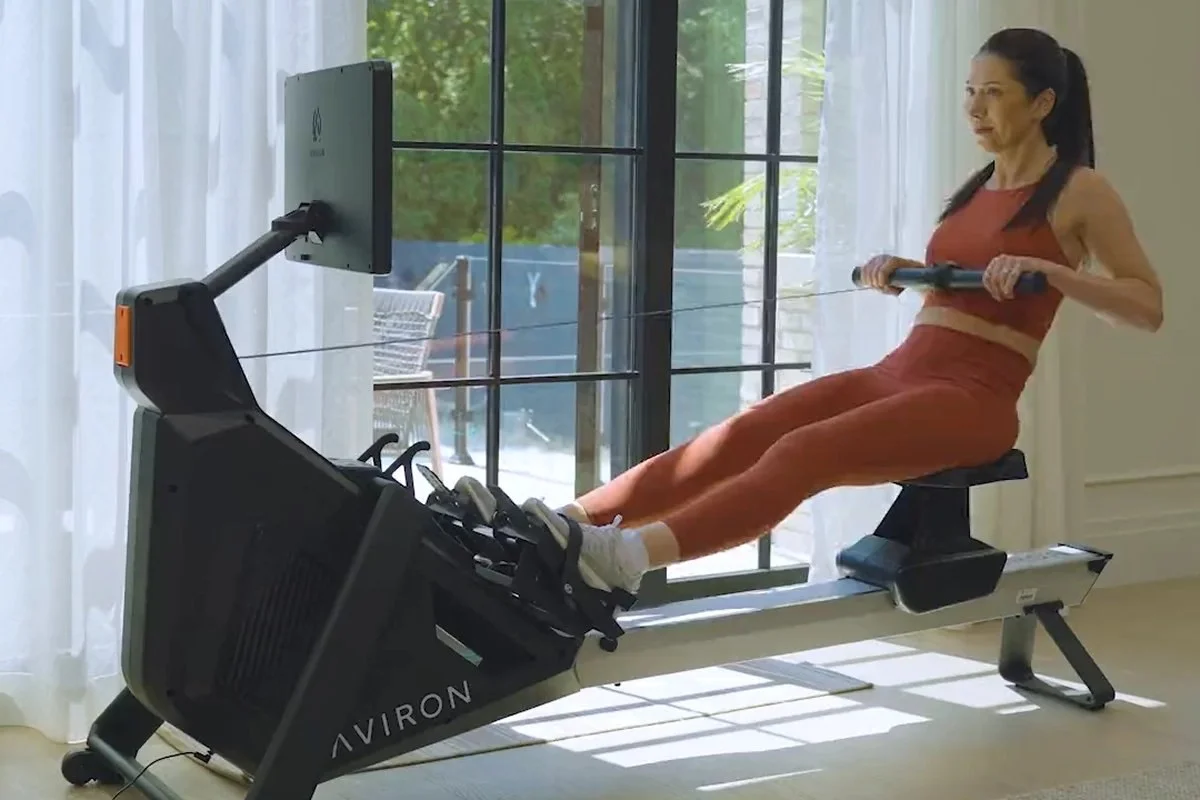
Use a 1 to 10 effort scale, where 10 is the hardest you can go, and back it up with the talk test. Stroke rate (strokes per minute, or spm, on your monitor) is only a rough guide:
| Effort | Out of 10 | Talk test | Stroke rate (rough guide) |
|---|---|---|---|
| Easy (recovery) | 3 to 4 | Full sentences | 18 to 22 spm |
| Hard | 7 to 8 | A few words at a time | 24 to 28 spm |
| Max | 9 to 10 | No talking | 28 to 32 spm or more |
The most common mistake is trying to go harder by rowing faster. A higher stroke rate with the same leg drive just gives you more short, choppy strokes. Push harder through the foot plates first, and let the rate climb a little on its own.
A heart rate monitor takes out the guesswork, especially in the easy blocks. If your heart rate never comes down between intervals, you're recovering too hard.

A lightweight armband that tracks real-time heart rate and calories over Bluetooth, with about 60 hours of battery.
1. What's a Good 10-Minute HIIT Rowing Workout for Beginners?
Beginner · 10 minutes
- Warm up: 2 minutes easy
- Intervals: 6 rounds of 20 seconds hard (7 to 8 out of 10), then 40 seconds easy
- Cool down: 2 minutes easy
Twenty seconds is short enough to hold good form all the way through, and 40 seconds is long enough to actually recover. When all six rounds feel manageable, move to 30 seconds hard and 30 easy. On the Strong Series, Short Stack (6 to 9 minutes of short intervals with rising resistance) is the ready-made version.
One warning about "just 10 minutes," from Strong Series owner Greg LaCour:
"I always think I am only going to work out for 10 minutes but it has consistently turned into 30 or 40 minutes."
2. How Do You Do a Rowing Pyramid? (15 Minutes)
Beginner to intermediate · 15 minutes
- Warm up: 5 minutes easy, with three 10-stroke pushes in the last 2 minutes
- Pyramid: 30 seconds hard, 30 easy; 45 hard, 45 easy; 60 hard, 60 easy; 45 hard, 45 easy; 30 hard, 30 easy
- Cool down: 3 minutes easy
Pyramids teach pacing. Go out too hot in the first 30 seconds and the 60-second middle will let you know. Aim to hold the same split (your pace per 500 meters) on every hard piece. On the Strong Series, Power Pyramid (10 to 14 minutes) builds stroke-rate control the same way, and coach John's Twenty's Plenty classes work through pyramids, ladders and waves.
3. What's the Best 20-Minute HIIT Rowing Workout?
Intermediate · 20 minutes
- Warm up: 5 minutes easy
- Intervals: 10 rounds of 40 seconds hard (8 out of 10), then 20 seconds easy
- Cool down: 5 minutes easy
That's 6 minutes and 40 seconds of hard work packed into 10, and those 20-second breaks start to feel very short by round six. Concept2 calls 40/20 its best workout for when you only have 20 minutes. On the Strong Series, HIIT Highway (9 to 25 minutes of fast 30-second intervals) is a close cousin.

Wayne Lynch was still new to his machine when he went looking for this kind of session:
"I was pleased when [I] went to the search bar and typed in HIIT Training and had a bunch of good options for high intensity interval training courses."
4. How Do You Do Tabata on a Rowing Machine? (20 Minutes, Advanced)
Advanced · 20 minutes
- Warm up: 5 minutes easy, with two 20-second pickups
- Tabata 1: 8 rounds of 20 seconds all-out (9 to 10 out of 10), then 10 seconds easy (4 minutes)
- Reset: 2 minutes easy
- Tabata 2: 8 more rounds (4 minutes)
- Cool down: 5 minutes easy
Ten seconds of rest is barely any rest, so save this one until the first three feel comfortable. Keep the handle moving lightly during the 10-second breaks rather than stopping dead, or you'll lose a stroke or two getting back up to speed. On the Strong Series, Tabata Takeoff (9 to 27 minutes) is the guided version, and Quick Strike (2 to 7 minutes of sprints) makes a brutal finisher.
Former NFL player Stephan Richmond, on the effort this machine pulls out of him:
"I mountain bike and can't get the same exertion like I did on my Aviron."
5. What's a Good 30-Minute Rowing Interval Workout?
Intermediate to advanced · 30 minutes
- Warm up: 5 minutes easy
- Intervals: 4 rounds of 4 minutes hard (7 to 8 out of 10), with 2 minutes easy between them
- Cool down: 3 minutes easy
This is a rowing take on the 4x4 from a 2007 Norwegian study. Runners held 90 to 95% of their max heart rate for four minutes at a time and improved their VO2max (a key measure of aerobic fitness) more than groups doing moderate, steady training. The trick is pacing: row the first interval as if you had to do a fifth. On the Strong Series, Peak Pursuit (20 to 50 minutes of high-intensity intervals) is the closest match.
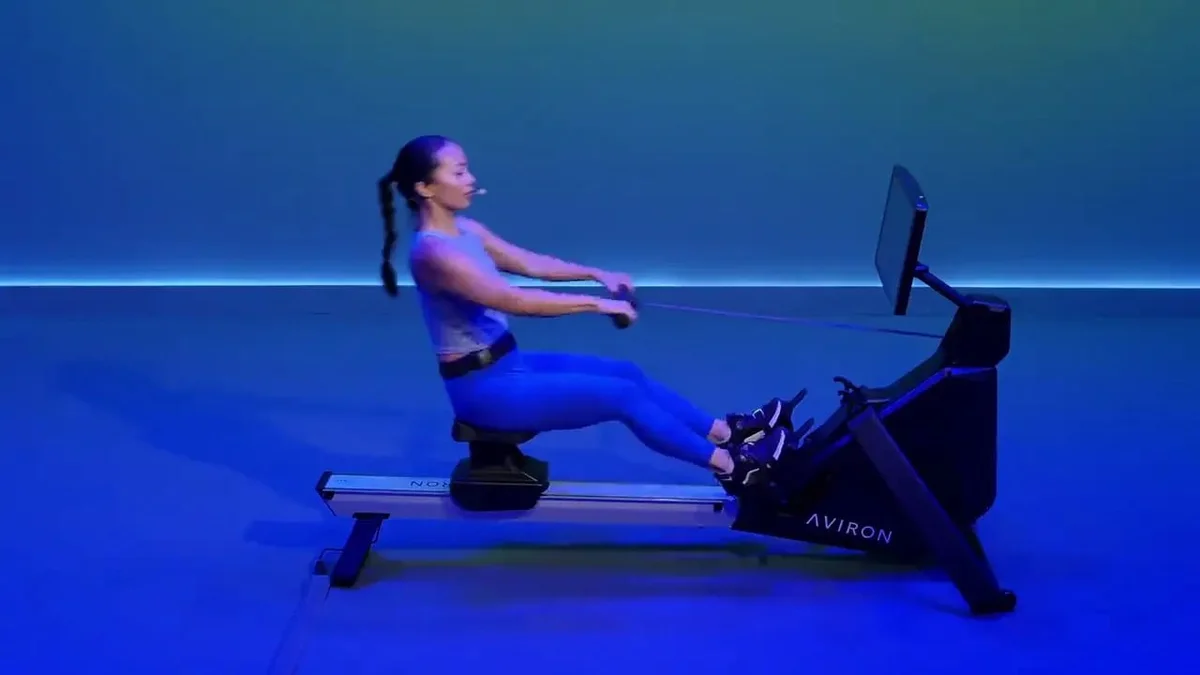
Ascent is an 8-class series with coach Jared that builds from stroke basics to peak-effort intervals, 20 minutes at a time. Fit in 15 packs power, tempo and sprints into 15 minutes. Coach Austin's programs are a favorite with members like Paul Harjung, 70:
"I particularly enjoy Austin's coaching style. He is focused on form, and tough but doable workouts."
How Often Should You Do HIIT Rowing?
Two to three times a week, with easier days in between. The American Council on Exercise (ACE) recommends 48 to 72 hours of recovery between HIIT sessions. If you do three or four a week, don't schedule more than two in a row.
More isn't automatically better. In research ACE summarizes, fitness gains were about the same whether people did HIIT two, three or four times a week. Longer sessions and more weekly HIIT time predicted more people dropping out. So start with two sessions a week you can keep up, and add a third once they feel routine.
Some people do work up to four. Sharon Maybrier did:
"From 0 exercise to 4 times a week interval workouts."
A simple week to start with:
- Monday: Workout 1 or 3
- Tuesday: an easy 20-minute row, or a scenic one
- Thursday: Workout 2 or 5
- Saturday: a game or race at whatever pace feels fun
How Do You Keep HIIT Rowing From Getting Boring?
Intervals fix the time problem. They don't fix boredom, and boredom is what turns a rower into an expensive clothes rack by month two. People blame their willpower, but most rowers were designed to be boring: a monitor and a number counting up. Your phone, meanwhile, was designed to be hard to put down.
Aviron took that same game psychology (points, streaks, levels, live competition) and built it into the rower. You do the same intervals, with something to chase while you do them. On the Strong Series you'll find:
- Power Play, where programs meet games: HIIT Highway, Quick Strike, Power Pyramid, and Clockwork (four timed rows from 1,200 to 2,400 meters)
- Guided workouts: Tabata Takeoff, Short Stack, Rocket Row, and Jekyll and Hyde (explosive sprints and power rows)
- Coached classes: Twenty's Plenty with John, Ascent with Jared, and Fit in 15
- Races: Tracks, Pros vs Joes, and live multiplayer when you want a real person to beat
Kimberly Mullett, who has five kids and a full-time job, describes what changed for her:
"ADD no problem. My mind is busy. Staying in zones, killing wolves, reaching the next bonus. I have reached limits I didn't know I was capable of because I was no longer thinking about the workout."
Workouts that pull you back are a big part of why 92% of Aviron members are still working out a year later. See everything on the menu in Aviron World.

Dual air and magnetic resistance across 16 levels, a seat 20 inches off the floor, and 1,000+ workouts, games and classes on the touchscreen.
What Are the Most Common HIIT Rowing Mistakes?
- Pulling with your arms first. The drive goes legs, then body, then arms. Lead with your arms and your biceps will be cooked by round two. Our rowing form guide covers the fix.
- Maxing out the resistance. Heavier doesn't make it HIIT. Pick a level where you can hold good form for the whole interval, then make the work harder by pushing harder.
- Skipping the warm-up. Your first hard stroke of the session shouldn't also be your first stroke of the day.
- Grinding through broken form. When your back starts rounding, end the round early. One extra rep isn't worth a sore back.

Mounts on the Strong Series handlebar so you can change resistance mid-stroke without letting go to reach for the screen.
Frequently Asked Questions
Can you do HIIT on a rowing machine?
Yes, and it's one of the best machines for it. Alternate hard efforts of 20 seconds to 4 minutes with easy rowing. A rower is low impact, works most of your major muscle groups, and lets you change intensity within a few strokes.
How long should a HIIT rowing workout be?
10 to 30 minutes, including warm-up and cool-down. The hard work itself usually adds up to 2 to 16 minutes. If you can keep going well past 30 minutes, you probably aren't working hard enough in the hard intervals.
Is HIIT rowing good for beginners?
Yes, once you know the stroke. Spend a session or two rowing easy and focusing on technique, then start with Workout 1. Our guide to your first month of rowing walks through it. If you have a heart condition or haven't exercised in a while, check with your doctor before doing high-intensity work.
Is HIIT rowing better than steady rowing for weight loss?
For fat loss it's about equal, but HIIT takes less time. A 2017 meta-analysis of 13 trials found that HIIT and moderate continuous training reduced body fat by similar amounts, with HIIT taking about 40% less time. Mixing both works well. More in Is Rowing Good for Weight Loss?
What resistance should I use for HIIT rowing?
A moderate level you can hold with good form for the full interval. Make the hard intervals harder by driving harder with your legs, not by cranking the resistance. Save the higher levels for slower, strength-focused pieces.
The Strong Series Rower comes loaded with HIIT classes, interval games and live races. The hard part is stopping.
Shop the Strong Series →30-day risk-free home trial · Free shipping · Financing available · HSA/FSA eligible


