Compact Rower vs Treadmill: Which Is Better for Small Spaces?
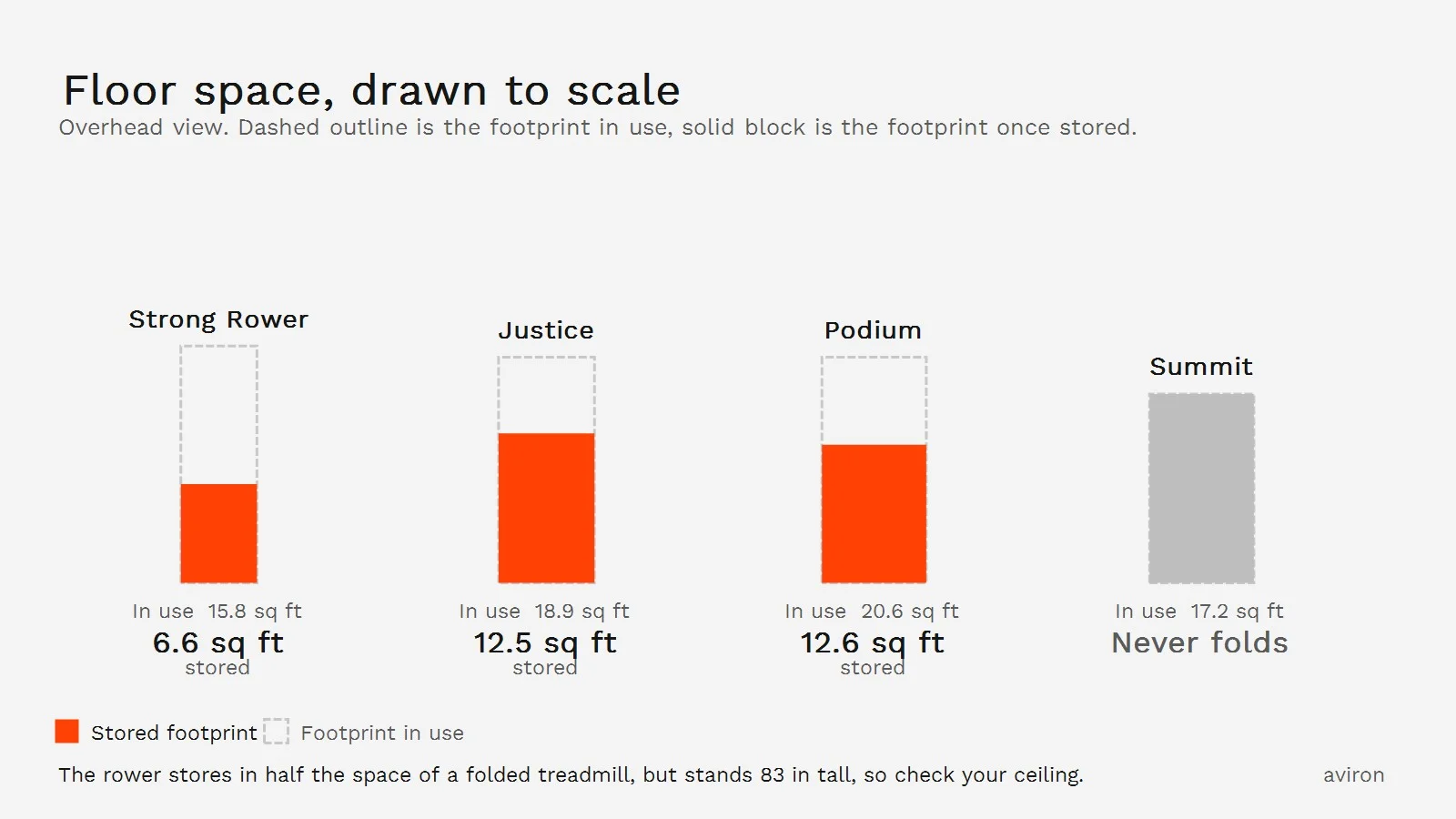
The rower wins on stored space, and it is not close: 6.6 square feet standing upright against 12.5 for a folded Justice. But it stands 83 inches tall when stored, so a room with low ceilings flips the answer. In use the two are closer than people expect, at 15.8 square feet for the rower and 18.9 for the Justice.
Most small-space advice stops at "get the folding one." That misses the question that actually decides it, which is not how small the machine gets but which direction it grows when you put it away. Here are the real numbers.
In this article
- The footprint numbers
- The ceiling height catch
- Space you need around the machine
- Noise, which matters more in a small home
- Which should you choose?
- FAQ
The Footprint Numbers
Every machine here is an Aviron, so the comparison is like for like on build and software. What changes is the geometry.
| Strong Series Rower | Justice | Podium | Summit | |
|---|---|---|---|---|
| Size in use | 84 x 27 x 48 in | 80 x 34 x 66 in | 80 x 37 x 66 in | 67 x 37 x 71 in |
| Floor space in use | 15.8 sq ft | 18.9 sq ft | 20.6 sq ft | 17.2 sq ft |
| Size stored | 35 x 27 x 83 in, upright | 53 x 34 x 68 in, folded | 49 x 37 x 68 in, folded | Does not fold |
| Floor space stored | 6.6 sq ft | 12.5 sq ft | 12.6 sq ft | 17.2 sq ft |
| Space reclaimed | 58% | 34% | 39% | None |
| Height when stored | 83 in, the tallest here | 68 in | 68 in | 71 in, permanent |
| Move it yourself? | Yes, 114 lb | Plan for two people | Plan for two people | Plan for two people |
| User capacity | 507 lb, up to 6 ft 8 in | 300 lb | 350 lb | 350 lb |
Three things stand out.
The rower reclaims nearly twice as much space. Standing upright it occupies 6.6 square feet, a little over half a folded Justice and about a third of a Summit. If the room has to become a room again after your workout, that is the number that matters.
In use, the difference is smaller than people assume. At 15.8 square feet the rower is only about three square feet tighter than a Justice. Anyone imagining a rower as the dramatically smaller machine is thinking of it folded, not in use. It is a long piece of equipment, and you need most of an eight-foot run for it.
The Summit is a slightly odd case. Its in-use footprint of 17.2 square feet is actually smaller than a Podium's, because the frame is 13 inches shorter. But it never folds, so in a shared room it is the largest of the four in practice. It earns that space with a 42% incline and a 6% decline, which is a fair trade if elevation training is the point, and a poor one if it is not.

Stands upright against a wall with no wall anchor, weighs 114 lb, and takes users up to 507 lb and 6 ft 8 in.
The Ceiling Height Catch
This is the part that catches people out, and it is the single most useful thing in this article.
A rower saves space by going vertical. Stored upright the Strong Series Rower stands 83 inches, which is 6 feet 11 inches. A standard 8-foot ceiling gives you 13 inches of clearance, which is fine. A 7-foot ceiling gives you one inch.
That makes basements, converted lofts, rooms under a staircase and anywhere with a sloped ceiling genuinely risky for a rower, even though those are exactly the rooms people try to put one in. Measure before you buy, and measure at the spot where the machine will actually stand rather than in the middle of the room.
The treadmills go the other way. Folded, the Justice and Podium are both 68 inches tall, well under any ceiling, but they keep roughly twice the floor. A folded treadmill is a wide, low object. A stored rower is a narrow, tall one. Pick the shape that fits the gap you actually have.
Space You Need Around the Machine
Footprint is not the same as required space, and this trips up more small-room plans than the machines themselves do.
- A rower needs clearance behind the seat. At the finish of the stroke you are near the back of the rail, so leave a foot or two behind the machine. You do not need space at the sides.
- A treadmill needs clearance behind the deck. Safety guidance for treadmills is to leave clear run-off space at the rear in case you step back off the belt. That is not optional space, and it is the reason a treadmill often needs more room than its dimensions suggest.
- Both need swing room to store. A rower has to tip up through an arc, and a folding treadmill deck has to swing through one too. Check the path, not just the destination.
- Ceiling matters twice for a treadmill. You are standing on a deck several inches off the floor while running, so your head is higher than usual. Low basement ceilings are a problem for tall runners even when the machine fits.
Noise, Which Matters More in a Small Home
In a small apartment, the machine you can use without annoying someone is the machine you will actually use. This is where the rower has a second, quieter advantage.
Aviron rowers are belt driven, which makes them the quietest machines in the range, at roughly 60 dB, about the level of a normal conversation. Treadmill noise is a different animal, because most of it is not the motor. It is your feet hitting the deck, and impact travels through floors in a way that a fan or a belt does not. The Podium runs at around 70 dB at maximum speed.
If you share a wall or live above someone, that difference is worth more than a few square feet. We went deeper on this in how loud is a rowing machine.

The smallest treadmill in the lineup, folding to 53 by 34 inches with one hand and only 68 inches tall when stored.
Which Should You Choose?
- Choose the rower if the room has another job, your ceiling clears 7 feet comfortably, and noise is a live concern. It reclaims the most floor, it is the quietest, and at 114 lb it is the easiest of the four to move on your own.
- Choose the Justice if you want to run, or your ceiling is low, or you want the machine to double as a walking desk. It folds to the smallest footprint of the three treadmills and stores at a height nothing will catch on.
- Choose the Podium if running is a serious part of your week and you can give up 12.6 square feet of stored space for a bigger deck and a stronger motor.
- Choose the Summit only if you have a dedicated space. It does not fold, so it is a permanent 17.2 square feet, and that only makes sense when steep incline is genuinely the training.
One more consideration that is not about space at all. Rowing works most of your body at once, so a rower covers strength and cardio in a way a treadmill does not. If you only have room for one machine, the one that does more jobs is worth something. We compared the two on that basis in rowing machines vs treadmills, and for the treadmills against each other, in Justice, Podium or Summit.
Frequently Asked Questions
Does a rower or a treadmill take up less space?
Stored, the rower, clearly. The Aviron Strong Series Rower stands upright in 6.6 square feet against 12.5 for a folded Justice and 12.6 for a folded Podium. In use the gap narrows to 15.8 square feet versus 18.9, so the advantage comes almost entirely from how it stores.
How much ceiling height do you need to store a rower upright?
At least 83 inches, which is 6 feet 11 inches, for the Strong Series Rower. A standard 8-foot ceiling leaves 13 inches of clearance. A 7-foot basement ceiling leaves one inch, so measure the exact spot where the machine will stand before ordering.
Which Aviron treadmill is best for a small apartment?
The Justice. It folds to 53 by 34 inches, stands 68 inches tall when stored, and takes the WalkDesk accessory so the same machine can be a walking desk during the day. The Podium is slightly larger, and the Summit does not fold at all.
Can you put a treadmill or rower in a bedroom?
Both work, and the deciding factor is usually storage shape rather than size. A stored rower is narrow and tall, so it fits beside a wardrobe or in a corner. A folded treadmill is wide and low, so it fits along a wall or at the end of a bed. Check which gap your room actually has.
Is a rower quieter than a treadmill?
Generally yes. Aviron rowers are belt driven and run at roughly 60 dB, about conversation level. Treadmill noise comes mainly from foot impact rather than the motor, and impact carries through floors, which matters if you have neighbors below. The Podium reaches about 70 dB at top speed.
Do you need to anchor a rower to store it upright?
Not the Aviron rower. It stands on its own against a wall with no wall anchor and no tools, which is part of why the storage footprint is so small. Still leave it somewhere it will not be knocked, particularly around children or pets.
Measure twice, then try it for 30 days
Every machine ships with a 30-day risk-free home trial and free returns, so the real test is whether it fits your room and your routine.
Shop Aviron →30-day risk-free home trial · Free shipping · 0% APR financing via Affirm · HSA/FSA eligible


