Best Treadmill for Walking (2026): 6 Features That Matter More Than Top Speed
Last updated November 2026
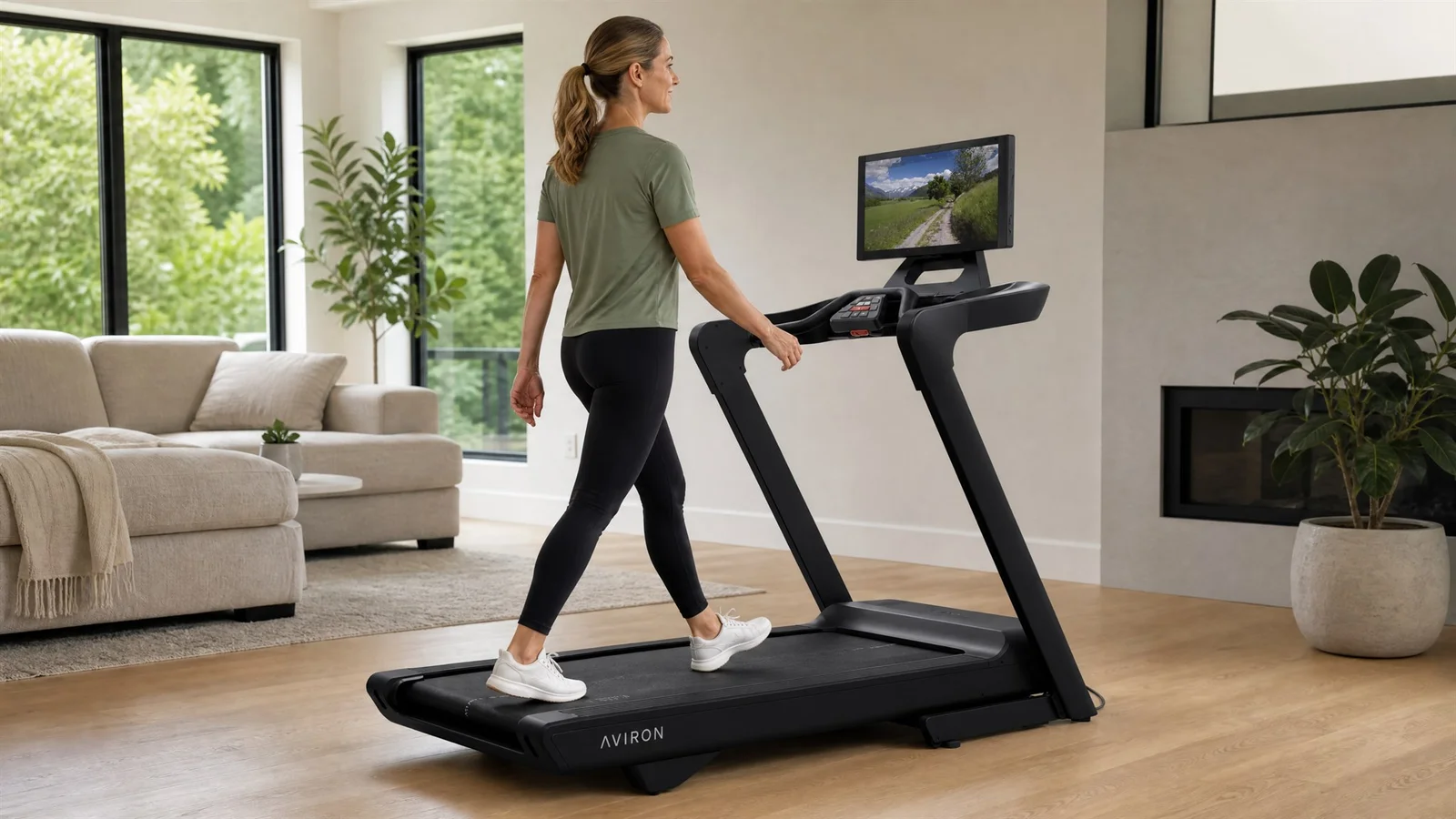
Short answer: The best treadmill for walking climbs to at least 12% incline, has a deck around 55 inches long and 20 inches wide, and runs a quiet motor rated at 1.75 continuous horsepower (CHP) or more. It should also fit your room and give you something to do for 30 minutes. Top speed barely matters. For most walkers, our pick is the Aviron Justice: 15% incline, a cushioned 20" x 59" deck, a 3.5 CHP brushless motor that runs at about 40 dB at walking speeds, a fold-away frame and an optional WalkDesk.
Treadmill spec sheets love to lead with top speed: 12 mph, 14 mph, sometimes more. If you're buying a treadmill to walk, it's the number you'll use least, since even a brisk walk rarely goes past 4.5 mph.
Judge a walking treadmill on what you'll feel every day: how steep it climbs, how the deck feels underfoot, how loud it is, where it lives, whether you can work on it, and whether you'll still want to step on it in month three. (Full disclosure: Aviron makes the Justice, Podium and Summit, the three treadmills compared here.)
In this article
- 1. How much incline do you need for walking?
- 2. How long should a walking treadmill deck be?
- 3. What motor size do you need for walking?
- 4. Will it fit your space and stay quiet?
- 5. Can you walk while you work?
- 6. What will keep you walking after week three?
- Which Aviron treadmill is best for walking?
- Which treadmill for walking should you choose?
- FAQ
1. How Much Incline Do You Need for Walking?
For walkers, incline does the job that speed does for runners. Raising the deck turns an easy pace into a real workout without the pounding of running.
The American College of Sports Medicine's walking equation puts numbers on it. For a 170-pound person walking 3 mph for 30 minutes:
| Incline at 3 mph | Effort (METs) | Calories in 30 minutes |
|---|---|---|
| 0% (flat) | 3.3 | About 130 |
| 5% | 5.4 | About 215 |
| 10% | 7.4 | About 300 |
| 15% | 9.5 | About 385 |
Estimates from the ACSM metabolic equation for walking. Your numbers will vary with body weight and fitness.
At 15%, the same 3 mph stroll costs nearly three times the energy of walking on the flat. Look for at least 12%, so you can do the 12-3-30 workout (12% incline, 3 mph, 30 minutes) with room to progress. For reference, Garage Gym Reviews' top overall pick for walkers, the NordicTrack Commercial 1750, inclines to 12%. The Aviron Justice climbs to 15% in 0.5% steps, the Podium to 18%, and the Summit to 42%, with a -6% decline for hikers training for real hills. Our incline treadmill guide goes deeper.
Build up to the steep stuff. "Don't overdo it at steep grades," exercise physiologist Chris Mohr told Garage Gym Reviews. "You run the risk of straining your Achilles heel or lower back, especially if you're unaccustomed to incline or decline training."
2. How Long Should a Walking Treadmill Deck Be?
Walkers need less belt than runners, though not as little as some walking pads suggest. Garage Gym Reviews favors walking treadmills with "at least a 50-inch walking surface" and recommends "at least a 55-inch deck" for taller walkers, roughly anyone over 6 feet.
Width matters too, because you drift sideways when you're reading or answering email. A 20- to 22-inch belt gives you room to wander without catching the edge. Many walking pads are just 15 to 17 inches wide.
Then check cushioning and capacity. Walking is low-impact, but an hour a day adds up on your knees, and GGR looks for a weight capacity of 300 pounds or more. The Justice has a 20" x 59" CloudStride deck with 8 shock absorbers, rated for users up to 6'6" and 300 pounds. The Podium's 22" x 60" deck takes users up to 6'7" and 350 pounds.

15% incline, a cushioned 20" x 59" deck and a quiet 3.5 CHP brushless motor, and it folds to a 53-inch footprint.
3. What Motor Size Do You Need for Walking?
Compare continuous horsepower (CHP), the power a motor can hold for a whole session, rather than peak horsepower. Garage Gym Reviews wants walking treadmills with motors that run "at least 1.75 CHP or higher." Extra headroom helps if heavier users, long sessions or the odd jog are in your plans.
Motor type counts too. Aviron's treadmills use brushless motors, which run quieter than a standard treadmill motor and have fewer parts to wear out. The Justice's 3.5 CHP is twice GGR's walking minimum, so there's room to jog when you're ready.
Then check how easy the slow end is to control. The Justice and Podium have one-touch speed keys (2, 4 and 6 mph out of the box) that you can change to your own walking paces, so you're not tapping the plus button 20 times at the start of every walk.
4. Will It Fit Your Space and Stay Quiet?
Walking treadmills usually live in shared space, like the living room or a home office, so footprint and noise matter more than they would in a garage gym.
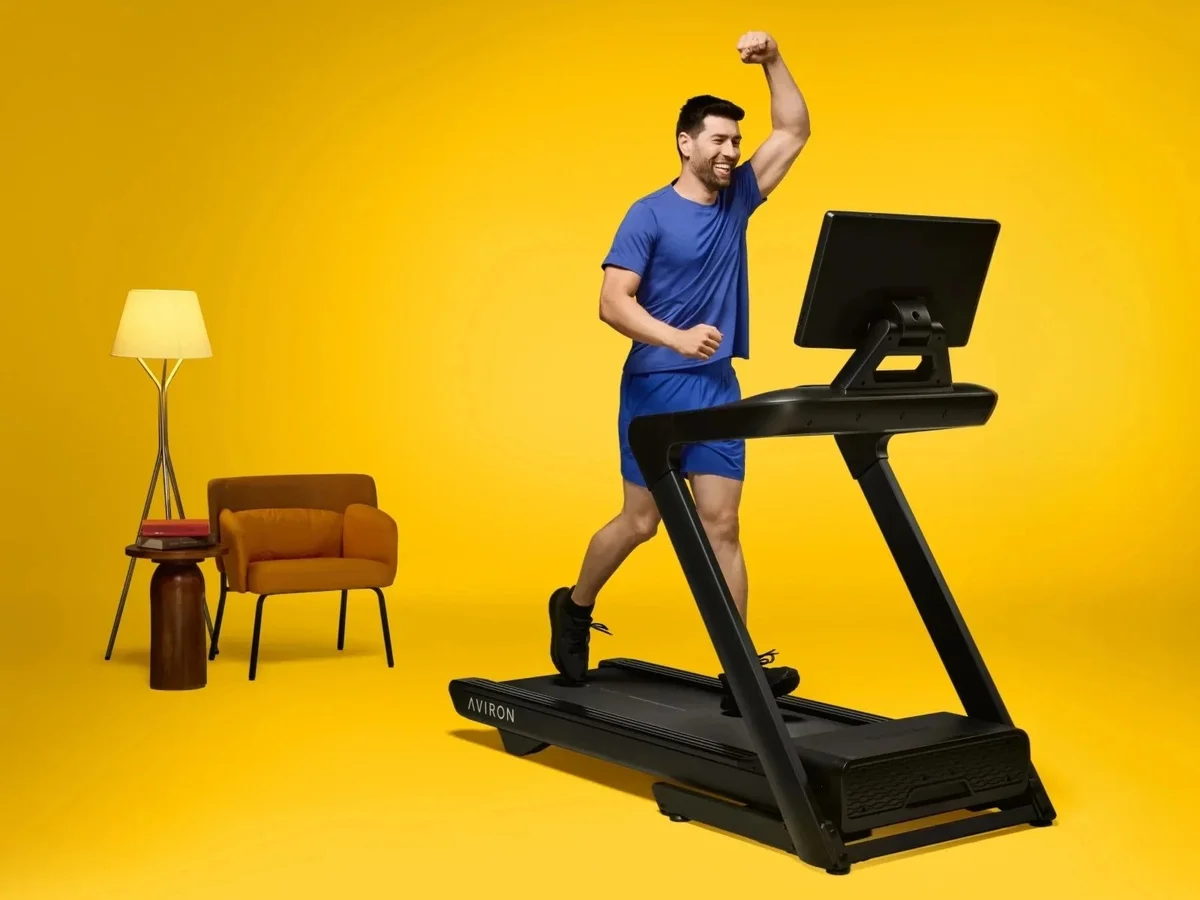
In use, the Justice is 80 inches long and 34 inches wide, and Aviron recommends leaving 24 inches clear on every side. When you're done, SafeLift's pneumatic assist helps you fold the deck up to a 53" x 34" footprint, and at 34 inches wide it fits through a standard 36-inch doorway. Our folding treadmill guide walks through the full space math. The Summit doesn't fold, so it only makes sense if it gets a permanent spot.
On noise, Aviron rates its brushless treadmills at roughly 40 dB at walking speeds, about the background noise of an average home, and around 70 dB at top speed. A mat underneath protects the floor and keeps the treadmill from shifting.
5. Can You Walk While You Work?
If your walking time keeps losing to your work time, combine them. In a small Mayo Clinic study of 15 office workers, walking at a self-chosen pace while working burned about 119 more calories an hour than sitting. Keep it slow: the people in that study settled on about 1.1 mph.
You need a stable, level surface for that. The Aviron WalkDesk snaps onto the Justice or Podium (not the Summit) and gives you a see-through desktop for a laptop or tablet. It stays level even when the deck is inclined, keeps the treadmill controls in view, and adds a cup holder and an accessory tray. One machine covers three jobs: walking pad, standing desk and full treadmill.
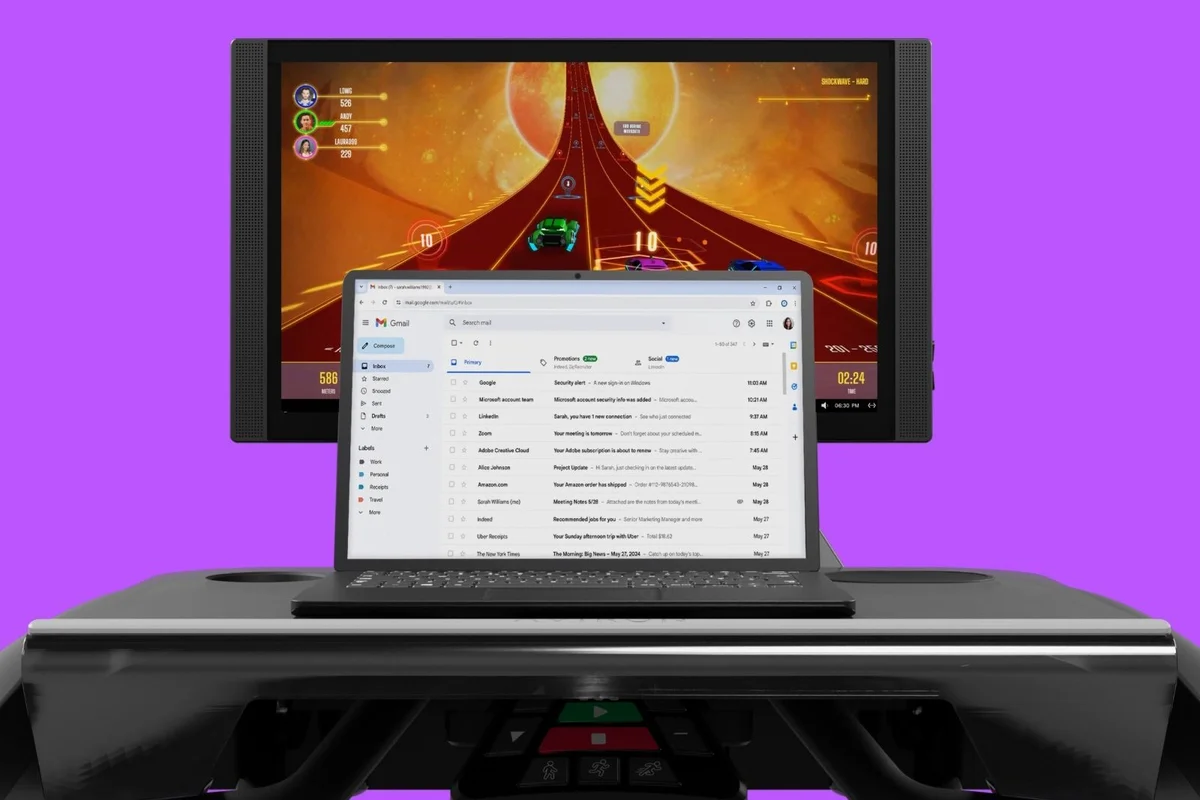
Already walking on a pad under your desk? That works for slow steps, but most pads top out around 4 mph on a short, narrow belt. Here's how a walking pad compares with the Justice.

Snaps onto the Justice or Podium and stays level, even on an incline, with the treadmill controls still in view.
6. What Will Keep You Walking After Week Three?
No spec sheet lists this one. The walking is easy; 30 minutes of watching a console count up the seconds is the hard part, and it's how so many home treadmills become an expensive clothes rack by month two. People blame their willpower, but treadmills were engineered to be boring, while the phone in your pocket was engineered to be hard to put down.
Aviron put that same game psychology into the treadmill. Aviron World adds points, streaks, levels and live competition to every walk, and many guided workouts adjust the incline for you. There's plenty to walk through:
- Coached walks: Daily Walks, Quick Walks of 15 minutes or less, Long Walks, Jenny's Power Walking series and Mindful Walking with coach Jared
- Scenic walks: stroll through Kinderdijk in the Netherlands, around Red Canyon in Utah or up the Serra de Monchique in Portugal
- Race walks: go 20 kilometers against Olympic medalists like Daniel Pintado, whose 2024 Paris gold-medal pace works out to 9.4 mph (good luck)
- Your own shows: Netflix, YouTube, Hulu, Disney+ and more, with your walk still tracked

Workouts that pull you back are a big part of why 92% of Aviron members are still working out a year later.
Which Aviron Treadmill Is Best for Walking?
All three handle walking well. They differ on incline, deck size, folding and desk support:
| Justice | Podium | Summit | |
|---|---|---|---|
| Best for | Most walkers, small spaces, walking while you work | Walkers who also run, busy households | Steep hill hiking and decline training |
| Incline | 0 to 15% | 0 to 18% | -6% to 42% |
| Deck | 20" x 59", 8 shock absorbers | 22" x 60", 8 shock absorbers | 22" x 61", 8 XL shock absorbers |
| Users up to | 6'6", 300 lb | 6'7", 350 lb | 6'8", 350 lb |
| Motor | 3.5 CHP brushless | 4.5 CHP brushless | 4.5 CHP brushless |
| Top speed | 12.5 mph | 14 mph | 14 mph (lower on steep grades) |
| Folds | Yes, to 53" x 34" | Yes, to 49" x 37" | No (67" long) |
| WalkDesk | Yes | Yes | No |
Specs are from Aviron. The Summit's top speed drops to 8 mph above 15% incline and to 6 mph above 25%.
Which Treadmill for Walking Should You Choose?
Choose the Aviron Justice if:
- You mostly walk, with the odd jog
- Space is tight or the treadmill has to fold away
- You want to walk while you work (add the WalkDesk)
Choose the Aviron Podium if:
- You walk and run, or share the treadmill with runners
- You want the wider 22-inch deck and still want it to fold
Choose the Aviron Summit if:
- Steep, hike-style incline walking is your thing and the treadmill can stay set up

4.5 CHP brushless motor, 18% incline and a wider 22" x 60" deck for users up to 6'7", and it still folds.
Still weighing them? Compare Justice, Podium and Summit side by side.
Our verdict: For most people, the Aviron Justice is the best treadmill for walking. It climbs to 15%, runs quietly at walking speeds, folds away, fits through a standard doorway and becomes a walking desk with the WalkDesk. If you also run, or you'll share it with runners, step up to the Podium. Both come with a 30-day risk-free home trial, so you can test it with your own walks.
Frequently Asked Questions
What is the best treadmill for walking at home?
For most people, it's one with at least 12% incline, a deck of 55 inches or more, a quiet motor of 1.75 CHP or higher and a footprint that fits the room. The Aviron Justice ticks all four and folds away, which makes it our pick for most home walkers. If you also run or share the treadmill with runners, look at the Podium.
What speed should you walk on a treadmill?
Most people walk comfortably at 2.5 to 3.5 mph, and a brisk walk runs from about 3 to 4.5 mph. At a walking desk, go slower: office workers in a Mayo Clinic study picked an average of 1.1 mph while working. If you want more of a workout, add incline before you add speed.
Will I lose weight walking on a treadmill 30 minutes a day?
It can help, but weight loss depends on your overall calorie balance, including what you eat. By the ACSM equation, a 170-pound person burns about 130 calories walking 3 mph for 30 minutes on the flat and about 300 at a 10% incline. Consistency is what adds up, so pick a treadmill and workouts you'll stick with.
Is walking on a treadmill as good as walking outside?
For most people, yes. You get the same cardio benefits either way. Walking outside adds uneven ground and fresh air, while a treadmill gives you a cushioned deck, incline on demand and no excuses when it's dark or pouring. The better option is the one you'll do most often.
Is walking on a treadmill bad for your knees?
For most people, no. Walking is low-impact, and a cushioned deck is softer underfoot than a sidewalk. Build incline gradually and keep your stride natural rather than reaching. If you have knee pain or an injury, check with your doctor first.
The Justice climbs to 15%, folds away and turns into a walking desk with the WalkDesk. Games, classes and scenic routes keep every walk from feeling like a chore.
30-day risk-free home trial · Free shipping · Financing available · HSA/FSA eligible


