10-Minute Postpartum Workouts for Busy New Mothers
Ten minutes is not a compromise. The American College of Obstetricians and Gynecologists recommends at least 150 minutes of moderate activity a week after having a baby, and says explicitly that you can split it into 10-minute sessions across the day. That target is something you build toward, not start at, and none of the sessions below need a babysitter.
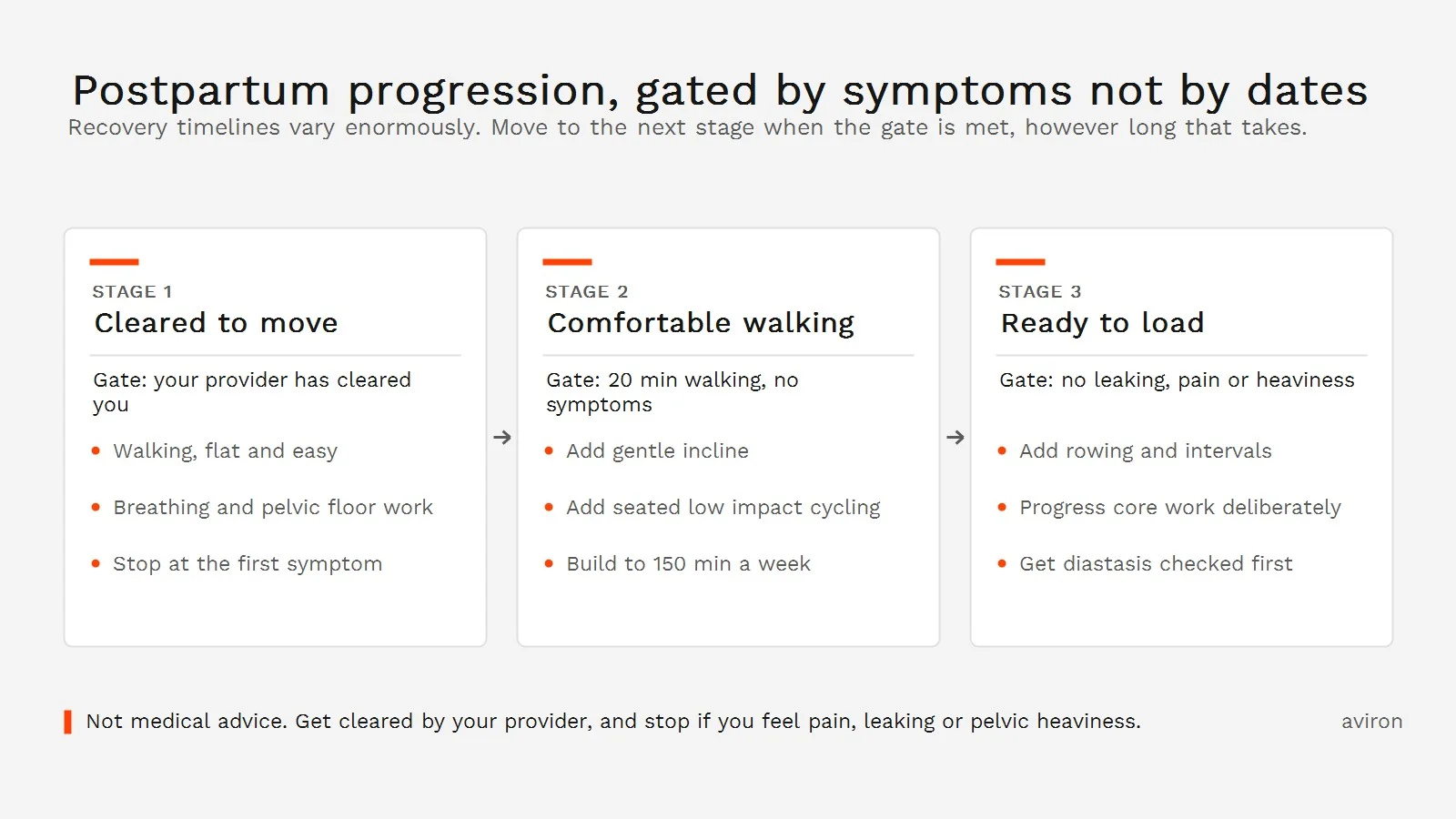
What follows is six sessions, sorted into three stages. Pick the stage that matches where your body actually is, not where you think it should be.
This is not medical advice. Get cleared by your doctor or midwife before starting, and tell them if you had a caesarean birth, a difficult delivery, or any complications. Everything below assumes you have been cleared. If a session causes pain, bleeding, urine leaking or a feeling of heaviness in your pelvis, stop and speak to your provider.
In this article
- When you can actually start
- Stage 1: cleared to move
- Stage 2: comfortable walking
- Stage 3: ready to load
- A word on core work and planks
- How to actually find 10 minutes
- Signs to stop
- FAQ
When You Can Actually Start
There is no universal date. ACOG says exercise may be resumed gradually as soon as it is medically safe, which depends on your delivery and whether there were complications. Some women are cleared within days. After a caesarean or a difficult birth it can be considerably longer. Both are normal.
So rather than counting weeks, use symptoms as your gate. You are ready to progress when you can do the current stage comfortably with no pain, no leaking and no pelvic heaviness afterwards. If those show up, you have found your ceiling for now, and that is information, not failure.
Moderate intensity, in ACOG's phrasing, means you are working hard enough to raise your heart rate and start sweating, but you can still talk normally. If you cannot hold a sentence, ease off.
If you want the wider picture on benefits and timing, we covered it in what is the best home workout postpartum. This piece is about the sessions themselves.
Stage 1: Cleared to Move
Gate: your provider has cleared you for gentle activity.
1. The ten minute flat walk
Ten minutes on a treadmill at a genuinely easy pace, no incline. Around 2.5 to 3 mph for most people. That is the entire session.
It sounds too small to matter. It is not. You are re-establishing the habit and testing how your body responds to load, with a handrail nearby and no pram to push. Do this three or four times in your first week back and pay attention to how you feel the next morning rather than during.
2. Breathing and pelvic floor reset
Five minutes, no equipment, and the least glamorous thing in this article. Lie on your back with knees bent. Breathe in and let your ribs widen and your belly rise. Breathe out slowly and, as you do, gently draw your pelvic floor up, as though stopping the flow of urine. Release fully on the next inhale.
Ten slow breaths, twice. The release matters as much as the lift. If you are unsure whether you are doing it correctly, a pelvic health physiotherapist is genuinely worth one appointment.

Folds up with one hand between sessions, so a ten minute walk never depends on having a spare room. Coached classes if you would rather be told what to do.
Stage 2: Comfortable Walking
Gate: you can walk 20 minutes with no pain, leaking or heaviness, during or after.
3. The incline ladder
Two minutes flat to warm up. Then two minutes at 2% incline, two at 4%, two at 6%, then two minutes back at flat to finish. Keep the speed the same throughout, around 3 mph, and let the incline do the work.
Incline raises your heart rate without asking your joints or pelvic floor to absorb any impact, which makes it the most useful setting on the machine at this stage. If 6% feels like too much, cap the ladder at 4% and stay there for a few weeks.
4. Seated bike intervals
Three minutes easy spinning, then six rounds of 30 seconds at a moderately hard effort with 30 seconds easy, then a minute to cool down.
Cycling is seated and fully supported, so there is no impact at all and no load through the pelvic floor from landing. For a lot of women this is the first session that feels like a real workout again, which does more for your head than the ten minutes does for your fitness.

Belt driven and quiet enough to use while the baby sleeps in the next room, with a minimum rider height of 4 feet 10 inches.
Stage 3: Ready to Load
Gate: no leaking, pain or heaviness during or after Stage 2, and your abdominal separation has been checked.
5. First rowing sessions
Ten minutes of easy rowing at a low stroke rate, around 20 strokes per minute, focusing entirely on sequence: legs, then body, then arms, and the exact reverse on the way back.
Rowing is low impact but it is not low demand. It asks a lot of your trunk, which is why it belongs here rather than in Stage 1. Keep your breathing steady and do not hold your breath at the catch, since bracing hard against a closed throat is exactly the pressure spike your pelvic floor does not need yet.
6. The ten minute mixed interval
One minute easy, then five rounds of one minute moderately hard and one minute easy on whichever machine you feel like. Finish easy.
By this point the specific machine matters less than showing up. Rotate between them so nothing gets stale, and take the option that fits the ten minutes you actually have.

Resistance adjustable mid-workout across 160 levels, so you can start genuinely light and add load on your own timeline.
A Word on Core Work and Planks
Most abdominal separation, or diastasis recti, closes on its own over the months after birth. Some does not, and loading it too early can make it harder to resolve.
Which means the classic advice to "just do planks" is worth ignoring until someone has actually looked at your abdominal wall. Front-loaded holds, crunches and sit-ups all push outward on the exact tissue that is trying to knit back together. We sell a plank trainer and we would still rather you got checked before you used it postpartum.
Start instead with the breathing work in Stage 1. Reconnecting the deep core and pelvic floor is what makes everything else safe later, and it is genuinely the foundation, not a warm-up.
How to Actually Find 10 Minutes
- Attach it to a nap, not a time. "At 7am" fails in week one. "First nap of the day" survives, because it moves when your day moves.
- Keep the machine set up and ready. If it takes four minutes to get going, a ten minute window is not a window.
- Let the baby be in the room. A bouncer next to the treadmill is a perfectly good arrangement, and no part of this requires solitude.
- Two fives count. ACOG's guidance is about accumulated minutes across the week. Split sessions are not a lesser version of the real thing.
- Skip the guilt. Ten minutes is not time taken from anyone. It is the thing that makes the other twenty-three hours more manageable.
Building toward 150 minutes
Ten minutes six times a week is 60 minutes, not 150. That is a perfectly good place to begin, and the guideline is a destination rather than an entry requirement. A realistic build, moving on only when the previous block feels easy and symptom free:
| Block | Sessions per week | Weekly minutes | Move on when |
|---|---|---|---|
| Starting out | 3 x 10 min | 30 | No symptoms the next day |
| Settling in | 5 x 10 min | 50 | Sessions feel easy |
| Building | 8 x 10 min | 80 | Two sessions in a day feel fine |
| Guideline met | 15 x 10 min, or longer sessions | 150 | This is the target, not the start |
Most people get there by lengthening sessions rather than adding more of them. Two twenty minute rides and three thirty minute walks is the same 150 minutes with far less scheduling.
Signs to Stop
Stop the session and speak to your provider if you notice any of these:
- Pain anywhere, including your back, pelvis or a caesarean scar
- Vaginal bleeding that restarts or increases
- Urine leaking during or after the session
- A dragging or heavy feeling in your pelvis
- A visible ridge or doming down the midline of your stomach when you exert
- Dizziness, or feeling wiped out for the rest of the day
None of these mean you are back to square one. They mean the dose was slightly too high today.
Frequently Asked Questions
Are 10-minute workouts actually enough postpartum?
Yes. ACOG recommends at least 150 minutes of moderate activity per week after pregnancy and states that this can be divided into smaller 10-minute sessions throughout the day. Six ten minute sessions a week is real, effective training, not a consolation prize.
When can I start exercising after giving birth?
When your provider clears you. ACOG says exercise can resume gradually as soon as it is medically safe, which depends on your delivery and any complications. Some women resume within days of an uncomplicated vaginal birth, while a caesarean or difficult delivery usually means longer. Ask at your postnatal check rather than working from a number you read online.
Is rowing safe after having a baby?
It can be, once you are cleared and past the walking stage, but it is not a first-week activity. Rowing is low impact yet demands real trunk control, so introduce it after you can walk and cycle comfortably without symptoms. Start at a low stroke rate, keep the resistance light, and do not hold your breath through the drive.
Can I do planks with diastasis recti?
Get assessed first. Planks, crunches and sit-ups load the abdominal wall outward, which can slow the recovery of a separation that has not yet closed. A GP, midwife or pelvic health physiotherapist can check the gap in a couple of minutes and tell you what is appropriate for your body.
What is the best exercise to start with postpartum?
Walking, plus breathing work that reconnects the deep core and pelvic floor. Both are low risk, easy to scale, and they build the foundation that cycling, rowing and eventually running all rely on. Treadmill walking has the advantage of a controlled surface and a handrail.
Is it safe to work out while breastfeeding?
Moderate exercise does not affect milk supply or quality. Practical comfort is the bigger issue, so many women prefer to feed or pump before a session and wear a supportive bra. Drink more water than usual, since you are losing fluid to both sweat and milk.
Ten minutes, on your schedule
Equipment that folds away, starts in seconds and tells you what to do, so the session fits the window you actually get.
Find your machine →30-day risk-free home trial · Free shipping · 0% APR financing via Affirm · HSA/FSA eligible


