HSA vs FSA: What's the Difference When Buying Fitness Equipment?
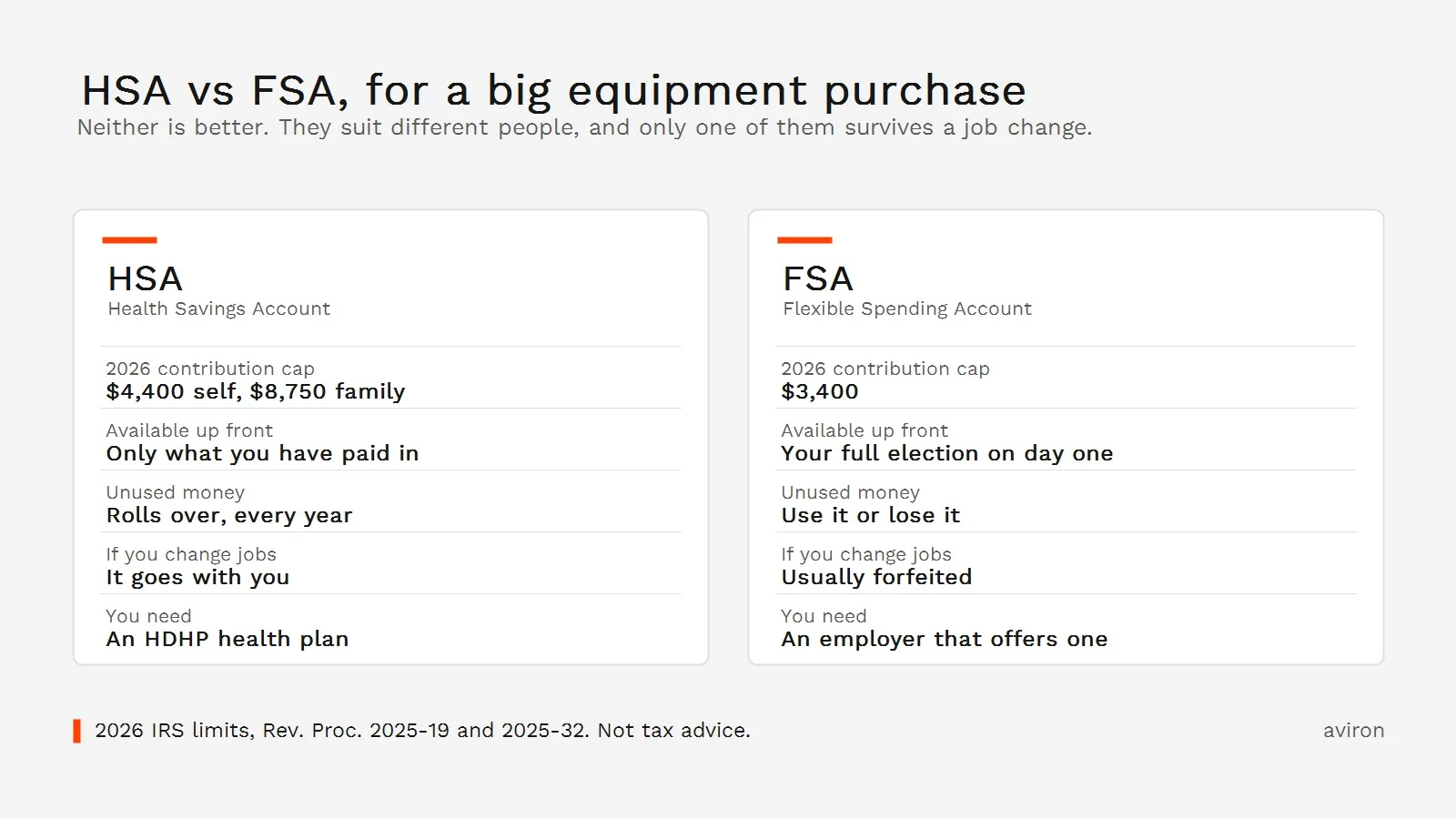
Both let you pay with pre-tax dollars, and for a single large purchase the practical difference comes down to timing. An FSA makes your entire annual election available on the first day of the plan year, so you can buy a machine in January using money you have not earned yet. An HSA only holds what you have actually contributed, but it rolls over forever and follows you if you change jobs.
The same route works for a rower, a treadmill or a bike, so the machine you want is rarely the deciding factor. There is a bigger catch that applies to both accounts, and most articles bury it: fitness equipment is not automatically eligible for either. Here is how the two differ, and what actually determines whether your purchase qualifies.
This is general information, not tax advice. Rules vary by plan and by individual circumstance. Check with your plan administrator and a tax professional before making a purchase you intend to claim.
In this article
- The short version
- HSA vs FSA, side by side
- Is fitness equipment actually eligible?
- Why timing matters for a big purchase
- How much you actually save
- How it works at checkout
- Which machines you can buy this way
- FAQ
The Short Version
An HSA is a savings account you own. You can only open one if you are enrolled in a high-deductible health plan, but once it exists the money is yours permanently. It rolls over year after year, it comes with you when you change employers, and it can be invested.
An FSA is an employer benefit. You elect an amount at open enrollment, it comes out of your paycheck in equal installments across the year, and you generally have to spend it within the plan year. Leave the job and you usually leave the balance behind.
Most people do not get to choose between them. You have whichever your health plan and employer make available, and a small number of people have both in a limited form. The comparison below matters most when you do have a choice, or when you are deciding when to buy.
HSA vs FSA, Side by Side
| HSA | Health FSA | |
|---|---|---|
| 2026 contribution cap | $4,400 self-only, $8,750 family | $3,400 |
| Catch-up at 55 plus | Extra $1,000 | Not available |
| Available at the start of the year | Only what you have contributed so far | Your full annual election, day one |
| Unused funds at year end | Roll over indefinitely | Forfeited, unless your plan allows a carryover of up to $680 or a grace period |
| If you leave your job | The account is yours and goes with you | Usually forfeited |
| Eligibility requirement | Enrolled in a qualifying high-deductible health plan | Your employer offers one |
| Can you invest it? | Yes, in most plans | No |
| Can you change your contribution? | Any time | At open enrollment, or a qualifying life event |
2026 figures from IRS Revenue Procedure 2025-19 (HSA and HDHP) and Revenue Procedure 2025-32 (health FSA). To qualify for an HSA in 2026 your plan needs a deductible of at least $1,700 self-only or $3,400 family.
Is Fitness Equipment Actually Eligible?
This is the part worth reading carefully, because the honest answer is not by default.
IRS Publication 502, which defines what counts as a medical expense, is direct about general fitness spending. It states that you cannot include "health club dues or amounts paid to improve one's general health or to relieve physical or mental discomfort not related to a particular medical condition." Buying a treadmill because you would like to be fitter does not qualify.
The door opens when the expense treats something specific. The same publication allows amounts paid "to lose weight if it is a treatment for a specific disease diagnosed by a physician (such as obesity, hypertension, or heart disease)." The deciding factor is a diagnosed condition and a clinical reason, not the product.
In practice that determination is documented in a Letter of Medical Necessity, a short document from a licensed provider stating that the equipment supports treatment of your condition. With one, equipment can be a qualifying expense. Without one, it is not, and claiming it anyway is the kind of thing that becomes a problem in an audit.
Both accounts follow the same eligibility rules here. The HSA versus FSA question is about how you fund and time the purchase, not whether it qualifies.
Why Timing Matters for a Big Purchase
For everyday expenses the difference between these accounts is mostly academic. For a single purchase in the low thousands, one rule changes everything.
An FSA has to give you the whole election immediately. Under what is called the uniform coverage rule, your full annual election must be available for reimbursement from the first day of the plan year, even though your payroll deductions have barely started. Elect $3,400 in January and you can spend $3,400 in January, then repay it over the following twelve months through your paycheck. Functionally it is an interest-free advance against your own pre-tax money.
An HSA does the opposite. You can only spend what has actually landed in the account. If you are contributing $4,400 across the year and it is February, you have a few hundred dollars available, not the full amount. For a large purchase early in the year, that is a real constraint.
Two practical consequences. If you have an FSA and you know you want equipment, the start of the plan year is the moment with the most purchasing power. If you have an HSA, either wait until the balance is there, or pay another way and reimburse yourself later, which HSAs allow as long as the expense was incurred after the account was opened.
How Much You Actually Save
The saving is not a discount. It is the tax you never pay on that money, so it depends entirely on your own rate.
Add your federal marginal rate, your state income tax rate, and, for FSA contributions taken through payroll, the 7.65% you would otherwise pay in Social Security and Medicare. For a lot of households that lands somewhere around 30%, which is the figure Aviron quotes on its product pages. Someone in a higher bracket in a high-tax state can see more. Someone in a low bracket in a state with no income tax will see considerably less.
Worth being clear-eyed about: this only helps if you were going to buy the equipment anyway and you genuinely qualify. It is a way to pay less tax on a purchase you have already decided on, not a reason to make one.
How It Works at Checkout
Aviron handles this through Truemed, which is US only and adds no fee. There are two routes:
- Pay directly. Select Truemed at checkout and pay with your HSA or FSA card.
- Pay and reimburse. Buy with a normal card, then complete the Truemed eligibility survey on the confirmation page and submit for reimbursement from your account.
Either way there is an eligibility step, reviewed by a licensed provider, which is what produces the Letter of Medical Necessity if you qualify. Not everyone will. For a walk through of the purchase itself, we covered it in can you buy a rowing machine with HSA or FSA.
One last thing that catches people out: keep the documentation. The letter, the receipt and the record of what you bought all need to survive as long as your tax records do, because the burden of proof sits with you rather than with the retailer.
Which Machines You Can Buy This Way
The route is the same across the range, so this is not limited to one type of machine. Rowers, treadmills and bikes all go through the same Truemed eligibility check at checkout, and the same rules apply to each: it is your diagnosed condition that determines eligibility, not which machine you pick.
Which one to choose is a separate question, and worth deciding on its own merits before the tax treatment enters into it.

Works most of your body at once with no impact through the joints, which is often the point when a provider is involved. Dual air and magnetic resistance, 507 lb capacity.

Justice folds away and takes a walking desk, Podium is the runner's machine, and Summit climbs to 42% with a 6% decline. All three run the same platform.

Seated, zero impact and belt driven, with a 4 foot 10 inch minimum rider height. Often the easiest starting point if load-bearing exercise is uncomfortable.
Frequently Asked Questions
What is the main difference between an HSA and an FSA?
Ownership and rollover. An HSA belongs to you, rolls over every year and moves with you between jobs, but requires a high-deductible health plan. An FSA belongs to your employer's benefit plan, generally has to be spent within the year, and is usually forfeited if you leave. The FSA's advantage is that your entire annual election is available from day one.
Can I use my HSA or FSA to buy a treadmill?
Potentially, but not automatically. Exercise equipment bought for general fitness is not a qualifying medical expense. It can qualify when a licensed provider documents that it treats a specific diagnosed condition, recorded in a Letter of Medical Necessity. Aviron runs that eligibility check through Truemed at checkout.
What are the 2026 HSA and FSA contribution limits?
For 2026 the HSA limit is $4,400 for self-only coverage and $8,750 for family coverage, plus an extra $1,000 if you are 55 or older. The health FSA limit is $3,400, with a maximum carryover of $680 into the following year if your plan permits one.
Can I have both an HSA and an FSA?
Not both in their standard forms at once. Having a general-purpose health FSA normally disqualifies you from contributing to an HSA. Some employers offer a limited-purpose FSA, restricted to dental and vision, which can be held alongside an HSA. Check with your benefits administrator, because the details matter.
What happens to FSA money I do not spend?
You generally lose it. Employers may offer one of two softeners: a carryover of up to $680 into the next plan year for 2026, or a grace period of up to two and a half months to spend the balance. They cannot offer both, and they are not required to offer either.
Does this work for a rower, a treadmill and a bike?
Yes, all three follow the same process. Aviron's rowers, treadmills and bikes each go through the Truemed eligibility check at checkout, and each can be paid for with an HSA or FSA card or submitted for reimbursement afterwards. What determines eligibility is your diagnosed condition and the provider's assessment, not the category of machine.
Do I need to be diagnosed with something to qualify?
Essentially, yes. The IRS standard is that the expense treats a specific condition rather than improving general health. A licensed provider makes that call during the eligibility review, and not every applicant will qualify. If you do not, the purchase is simply a normal purchase.
Check your eligibility at checkout
Every Aviron machine can be paid for with an HSA or FSA card through Truemed, or bought normally and submitted for reimbursement. US only, no extra fee.
Shop Aviron →30-day risk-free home trial · Free shipping · 0% APR financing via Affirm


